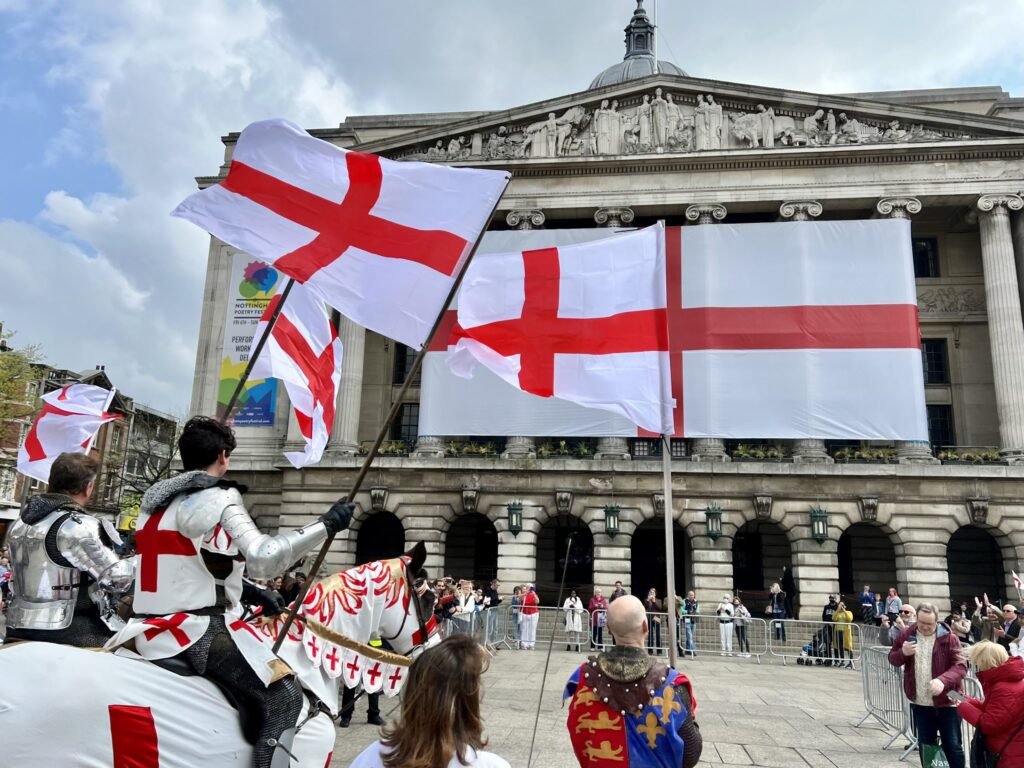
Why is it that out of all the peoples on earth, it’s the English who are told we’re not allowed to be proud of who we are?
Every time I post about England now, the pattern is the same. The posts fly, the comments go mad, normal people nod along because it matches what they see and feel every day – and then the usual online “experts” turn up. You know the type. Anonymous accounts with a flag in the bio, blue‑ticks who’ve never set foot in a proper English pub, professional activists who think England is just a “problem” to be managed.
And they all do exactly the same dance:
- “Who even is English, though?”
- “English isn’t an ethnicity.”
- “Being proud of being English is basically racism.”
It’s constant. It’s boring. And it’s not honest.
I want to put something down, clearly and calmly, that they’ll really struggle to wriggle out of. Not anger, not hate – just facts, lived experience, and basic logic.
What we actually mean when we say “English”
Let’s start with something that drives me mad.
When I say “English”, I am talking about the historic people of this country. The folk whose parents and grandparents and great‑grandparents lived in England, spoke English, worked, fought, prayed, loved and died here. The people whose surnames you see on village war memorials and parish registers going back centuries.
In other words: ethnic Englishness. Lineage. Ancestry. A people.
That doesn’t mean:
- I deny that there are also British citizens from every background living here now.
- I think someone with a different background can’t love England or call themselves English in a broader civic sense.
It simply means I recognise that there is a rooted English people, just as there are Pakistanis, Nigerians, Poles or Indians. We’re not some vague fog that magically started in 1948 when a politician signed a bit of paper. We were here long before any modern passport was invented.
And the funny thing is: ordinary people have always understood this instinctively.
My own family is a perfect example. My nan’s brother, Siddy, from Poplar, E14 – proper East End, the sort of bloke “Call The Midwife” is based on – married a Spanish woman, Anna. Between them they had 22 kids. They lived the most English life you could imagine: East London, grafting, big family, neighbours in and out, the whole lot.
But ask them what they were and they’d tell you straight: “The kids are half English, half Spanish.”
No drama. No identity seminar. Just common sense.
Mum’s English. Dad’s Spanish. So the children are half and half. Culturally they were English as anything, but they still recognised that, ancestrally, they weren’t “full English”. No one needed a 900‑page report to work that out.
That’s all I’m doing when I talk about “full English” and “half English”. It’s how our grandparents spoke. It’s how normal people still speak now if you let them be honest.
Before “British” swallowed everything
Another thing the online experts love to do is hide behind legal labels.
“The passport says British, not English. Therefore, English identity doesn’t really exist. Therefore, shut up.”
Let’s just rewind history a bit.
Before the Acts of Union in 1707, people in England were English or they were foreigners. Simple as that.
There was no fuzzy “British” nationality like we use now. There was the Kingdom of England, the Kingdom of Scotland, and so on. If you were from England, you were English. If you weren’t, you were foreign – or you were called by your own people’s name: Scots, French, Dutch, whatever.
How mixed was England at that point? Historically, not very. Serious estimates suggest that around 1700 only about one per cent of the population in England were born abroad, mostly clustered in London and a few towns. Almost everyone you met in day‑to‑day life was English by birth and by ancestry.
And even most of that tiny foreign‑born group were not from the other side of the world. The main immigrant communities in England were French Huguenots and other Protestant refugees from France and the Low Countries, plus smaller numbers of German Palatines and Jews. There was a small African presence in London and some ports – a few thousand people in a country of millions – but in the main, the people around you were English, through and through.
So when I say “there is an English people”, I’m not conjuring something out of thin air. It’s how this place has understood itself for centuries. The Union with Scotland, and all the later stuff about “Britishness”, came later as a political arrangement. It didn’t erase the English overnight.
When law pretends to overwrite reality
Now look at what happened in the 20th century.
In 1948, Westminster passed the British Nationality Act. On paper, pretty much the entire Commonwealth – hundreds of millions of people – were suddenly “British subjects” or “Commonwealth citizens”.
Did that law change their ancestry? Did it mean a farmer in Punjab and a docker in Poplar suddenly became “the same people”? Of course not.
All that happened was this: politicians created a legal label that covered wildly different peoples under one word. It was useful for them in the aftermath of empire. It made certain bits of administration and migration policy easier. But it was a political choice, not a discovery of some new “British race”.
That’s the key point:
- A law can create a status (who has what passport, who can move where).
- A law cannot create a people out of thin air.
Just because Parliament says, “You are all X in law,” doesn’t mean you are all the same in ancestry, history or identity. It doesn’t mean an English family in Essex and a Jamaican family in Kingston suddenly share a bloodline. It doesn’t make an Indian or a Nigerian or a Canadian into “the same people” as an English villager just because the word “British” appears on their paperwork.
This is why I say: just because a government makes a law, it doesn’t turn politics into truth. It doesn’t turn hundreds of separate nations into a single people.
The Bradford example – one rule for everyone
Let’s take a present‑day example that everyone understands, even if they pretend not to.
Imagine your parents are both from Pakistan. You live in Bradford, in a tight Pakistani community. Your mum doesn’t really speak English – which is very common. Your social circle is mostly Pakistani. Your culture, language at home, religious life, marriage patterns – all Pakistani.
What are you, ethnically?
You’re Pakistani. That’s not an insult. That’s not excluding you. That’s just how ancestry and community work.
On paper, yes, you might be British by passport. You might even call yourself British by identity, and I have no problem with that. But ethnically, in the sense of “who are your people?”, the answer is Pakistani.
Most people would accept that instantly. Many would be proud of it. The state itself, on official forms, encourages people from that background to write “Pakistani” as their ethnic group. There are endless campaigns and initiatives around “British Pakistani” identity. No one screams, “You can’t say that, it’s racist to recognise a Pakistani people!”
Now flip the situation.
Two English parents, English town, English culture and language, English family history. By the same logic, that person is ethnically English.
Suddenly, certain people lose their minds. “There’s no such thing as ethnically English.” “That’s dangerous.” “You’re basically far right if you say that.”
It’s a blatant double standard.
My position is simple: apply one rule to everyone. If it’s perfectly acceptable to say “this person is ethnically Pakistani, British by passport,” then it is equally acceptable to say “this person is ethnically English, British by passport.”
Anything else is just politics and prejudice – against the English.
Born here, born there – it doesn’t rewrite bloodlines
Another way the argument gets twisted is with birthplace.
The logic goes: “If you’re born here, you’re English. End of story.”
All right, let’s stress‑test that.
Take Cape Verde, where my fiancée and I love to holiday. Imagine we’re there, she happens to go into labour early, and the baby arrives on Cape Verdean soil.
Does that mean the child is suddenly African in ancestry?
Of course not.
Legally, the child would be British by descent because of the parents. Culturally, they’d grow up English if we raise them here. Being born on an island off the coast of Africa doesn’t overwrite the fact their parents are English. Nobody sensible would say, “No, you’re not English at all, you’re African now because of the GPS coordinates of the hospital.”
Everyone understands this when you move the example abroad. Place of birth is one piece of the puzzle. It might affect your passport. It might affect how you feel. But it doesn’t magically rewrite who your grandparents were.
Yet back home, some people suddenly pretend ancestry doesn’t matter. They’ll insist that someone with no English family background at all is exactly as “ethnically English” as someone whose family has been here for 500 years, simply because both were born inside the same postcode.
Again, it’s not honest. It’s not how they’d talk about their own group. It’s just another trick used when the topic is Englishness.
Loud voices aren’t truth
Something else needs saying.
A lot of the people trying to redefine us have one thing going for them: volume.
Big platforms. Big followings. Friendly media. They’re very loud online. Algorithms push their stuff. Institutions invite them to sit on panels and write guidance. So their version of reality gets amplified, repeated, and eventually people start to treat it as if it’s simply “how things are now.”
But a big microphone doesn’t turn politics into fact.
Just because someone shouts “English isn’t an ethnicity” to half a million followers doesn’t mean they’ve discovered some deep truth. It just means the right people share their content. The same way being on a list of “experts” doesn’t mean you’ve suddenly got the power to decide which peoples are allowed to exist in their own name.
Volume isn’t truth. It’s just reach.
And if you actually listen carefully to what they’re saying, it’s full of contradictions:
- Ethnicity matters hugely for some groups; for the English, it mustn’t be mentioned.
- Roots, heritage and ancestors are sacred – except when English people talk about theirs.
- National pride is celebrated for everyone else; for us, it’s a warning sign.
You don’t need a degree to see the pattern. You just have to be willing to notice it.
What English pride is – and what it isn’t
Let me be absolutely clear about something.
I don’t lie awake at night hating any race. I don’t want people kicked out just because of their skin colour. I don’t think I’m better than anyone else because I was born English.
What I do believe is this: England is our only home, and we have every right to run it in the interests of the English people.
That means I can feel deep pride in being English – in our history, our character, our way of life – and at the same time say: there are people here who should never have been allowed in, people who are actively harming this country, and people who are simply not part of the English story and never will be. Those things are not contradictions. They follow from the same basic truth: this is our house.
If it’s our house, we set the rules
Think of England as a family home.
If you invite someone in as a guest and they wreck the place, you show them the door. If someone breaks in without permission, you don’t say “oh well, they’re inside now so it’s cruel to ask them to leave” – you call that what it is: trespass. If someone moves in, never helps with the bills, never lifts a finger, and bad‑mouths the family non‑stop, you’d tell them to pack their bags.
We all understand this when it’s about a house.
I’m simply saying the same principle should apply to a country.
For me, that means:
- Illegal immigrants go. I don’t care if they’re white or not, rich or poor. If you came here by lying, breaking the border or gaming the system, you should be removed. No special pleading, no endless appeals.
- Foreigners who commit crimes go. Again, I don’t care about their skin colour. If you’re not English and you come here, commit serious crime, or make a career out of hurting the people who gave you a home, you’ve broken the deal. Out.
- Foreigners who don’t contribute should be on thin ice. If you’re not English and you’ve spent years here doing nothing but living off the system, not even trying to integrate, learn the language, work or give back, why are you here? What exactly is the benefit to the English people?
That’s not hate. That’s basic self‑respect.
A country that refuses to defend its borders, that protects foreign criminals more than its own citizens, and that rewards people for doing nothing while taxing its own to death is a country that has forgotten whose interests it’s meant to serve.
1948 and after: who is this really for?
I’ve already talked about the 1948 British Nationality Act trying to turn hundreds of millions of Commonwealth citizens into “British subjects” on paper. It was a political decision, not a discovery of some new shared people.
Since then, there’s been a constant pattern: laws made in Westminster that expand rights, expand eligibility, expand who can come and what they can claim – and the one group that keeps losing out quietly in the background is the English.
Ask yourself:
- Has mass immigration since the 1950s made housing cheaper for the English?
- Has it made our wages higher?
- Has it made our services easier to access, our schools less crowded, our roads clearer?
If the answer to those questions is “no” – and for most ordinary English people it is – then we have to stop treating every change in immigration and nationality law as holy writ and start doing what every normal country does: asking, is this actually benefitting our people?
If someone came here after 1948 and they’ve worked hard, obeyed the law, raised a family, genuinely become part of the fabric of this country, that’s one conversation.
If they came after 1948, have done nothing but take, break, or undermine the place – that’s another.
I’m not pretending it’s as simple as pressing a big red button and sending “everyone since 1948” away. Life isn’t that neat. But I am saying the principle is right: if a person being here doesn’t benefit the English people – and in plenty of cases actively harms us – we should have the courage to say so and act accordingly.
Remigration, without games or euphemisms
People throw around words like “remigration” and try to make it sound mysterious or sinister. Let’s strip it back to basics.
I believe in:
- Removing people who are here illegally.
- Deporting foreign criminals as a matter of routine.
- Stopping the import of people who clearly have nothing to offer this country and no intention of ever becoming part of it.
If that means some people who have come here in recent decades go back to their country of origin, so be it. If that means certain communities shrink over time as people return home or move somewhere that actually suits them, so be it. That’s not ethnic hatred. That’s a nation putting its own people first for once.
And to be crystal clear: this cuts all ways. If a white foreigner comes here, breaks the law, or lives off our system while giving nothing back, I want them gone every bit as much as anyone else. This is not about skin colour. It’s about loyalty, contribution and respect for the English.
Pride with a backbone
So when I talk about being proud of being English, it is not some soft, empty slogan.
It’s pride with a backbone.
It says:
- We exist as a people, and we are allowed to say so.
- Our history matters. Our roots matter. Our future matters.
- Our laws and policies should put the English first, not treat us as an afterthought.
- People who come here as guests or new citizens must respect the house they’re entering – or leave.
Everyone else in the world is allowed to take that for granted. Pakistan puts Pakistanis first. Nigeria puts Nigerians first. Poland puts Poles first. No one screams at them for it.
The moment an Englishman says, “I think England should put the English first,” he’s told he’s dangerous, hateful, or stuck in the past.
No.
I refuse that framing.
We are not asking for permission to exist. We are not asking to be liked by people who despise us anyway. We are simply doing what every healthy people does: defining who we are, defending what is ours, and insisting that those who come here either respect that – or go somewhere that suits them better.
That, to me, is what true English pride looks like.