I’m English, Not Your Punchbag
Let’s cut the nonsense.
If you say you’re an English nationalist today, too many people jump straight to “ethno‑nationalist”, “far‑right” or “Neo‑Nazi”. They don’t ask what you actually believe. They don’t read what you’ve written. They just slap a label on you and hope you shut up.
I’m not playing that game.
I’m English. My family has been here for over 400 years. I care about my country, its people, its history and its future. That doesn’t make me a Nazi. It makes me normal.
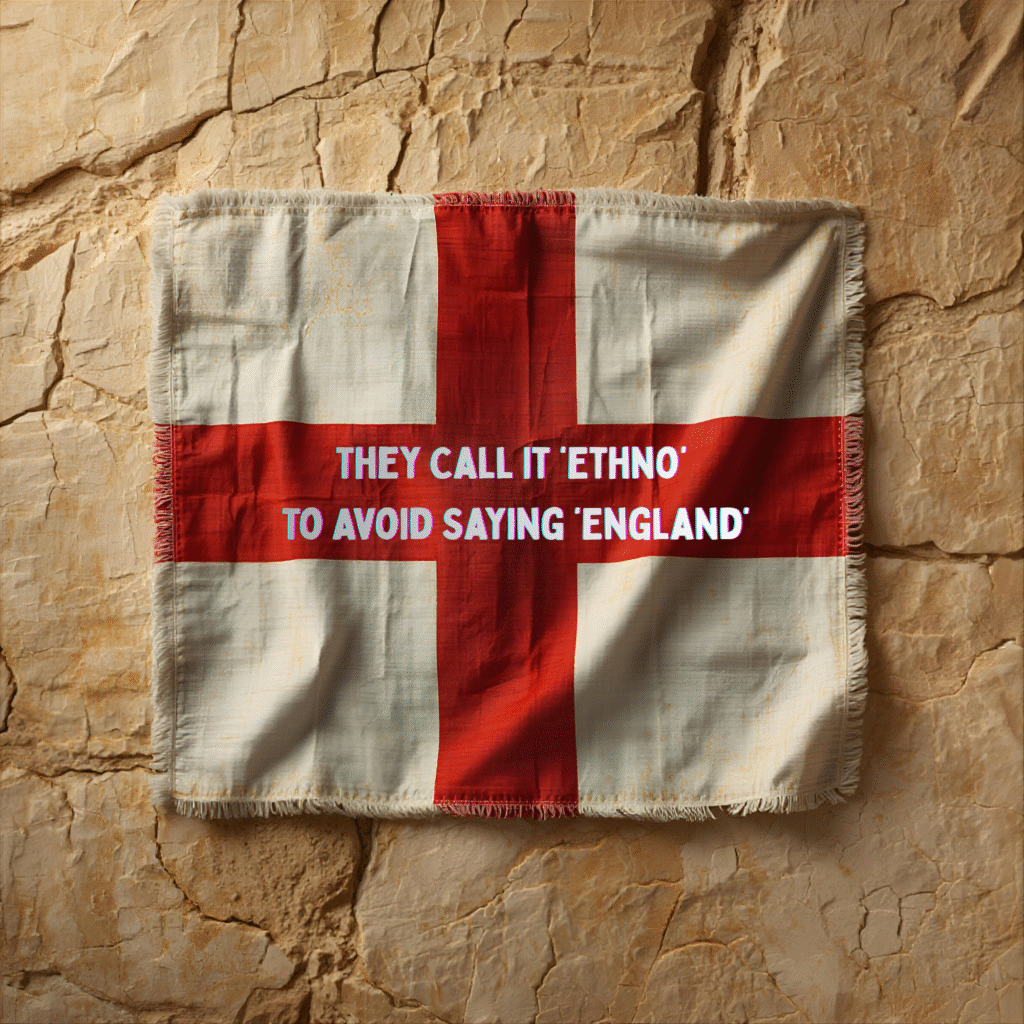
In this article, I’m going to explain exactly why They Call It ‘Ethno’ To Avoid Saying ‘England’, what I actually mean by English nationalism, why the English as a historic people matter, and how to answer these smears without backing down or watering anything down.
What I Mean When I Say “English Nationalist”
Here’s my position in plain language, no B/S:
- England is a real nation, not just a region on a map.
- The English are a historic people, not a random crowd in a shopping centre.
- A nation has the right to borders, laws and a government that answers to its own people.
- Therefore, England should have its own parliament, control its own borders and put the interests of the English first.
That’s what I mean by English nationalist.
I’m talking about:
- Law
- Borders
- Sovereignty
- Duty
- Loyalty to England
I’m not talking about some fantasy racial purity test. I don’t need a colour chart or a DNA kit to know what I believe. If you respect the country, follow the law, integrate into our way of life and put England first, you’re part of the national project. If you want to wreck it, bleed it dry or hand it over to foreign powers, then no – you’re not on my side, whatever your passport says.
That’s the line. Simple, firm, and not up for “reinterpretation” by people who need everyone to be guilty just for being English.
The English Are a Historic People – That Matters
Let’s talk about roots.
My family has been here for over 400 years. That’s not a boast. It’s a fact. Generations of my people were born here, worked here, paid taxes here, fought in wars, buried their dead in this soil. A lot of English families can say the same.
What does that mean in practice?
- It means I have history here.
- It means I have skin in the game.
- It means when I see England being run down, asset‑stripped and mocked, I take it personally – because my bloodline didn’t sit here for centuries just so some career politician can give the country away for a job in Brussels or a pat on the head from the UN.
Recognising the English as a historic people does not mean “everyone else get out.”
It means: this isn’t just an office block you can sell, refit or knock down whenever you feel like it. It’s a country built by real people over a very long time, and we owe them and our kids some loyalty.
Every other serious country understands this. The Japanese understand it. The Poles understand it. The Irish understand it. Somehow when the English say the same, it’s treated like a hate crime.
That’s one of the reasons They Call It ‘Ethno’ To Avoid Saying ‘England’ – because once you admit the English are a historic people, you have to accept we have a right to continuity, not endless experiments at our expense.
The English Constitution and Who Should Hold Power
Now we get to a point almost nobody wants to touch: who should be allowed to hold serious power over the English?
The old English constitutional view was straightforward:
If you are going to rule the English, your loyalty has to be to England and the English people – first, last and always.
That’s why there were rules about:
- No foreign control over our laws or courts.
- No foreign prince, prelate or power having authority here.
- And yes, in key roles, expectations about parentage and allegiance – because your background shapes your loyalties.
The principle is simple:
- If your parents are English, raised here and rooted here, it is much harder (not impossible, but harder) for you to casually sell England down the river.
- If your ties, money, family and future are split across other states, empires or global institutions, it is much easier for you to treat England as just another bargaining chip.
That’s not “hate”. That’s basic common sense.
Any normal person understands you don’t put someone in charge of your house if they’ve openly said they don’t care if it burns down.
So when I say I want the people who hold power over England to be English – including by parentage – I’m talking about loyalty and conflict of interest, not race worship. I want leaders whose blood, history and future are tied to this country, not people who will trade us away for their next job or their next contract.
You can disagree with that. Fine. But don’t insult my intelligence by pretending that’s the same as a swastika.
Why They Call It “Ethno”: The Smear Trick
So why do the usual suspects keep calling people like me “ethno‑nationalist”?
Because it’s a cheap trick that does three things at once:
- It avoids saying “English”.
Saying “English nationalist” forces you to admit England exists as a nation. They don’t want that. They want “British”, “European”, “global citizen”, anything but the E‑word. They Call It ‘Ethno’ To Avoid Saying ‘England’ because England is the one thing they can’t control if it wakes up. - It jumps straight to “Nazi” without proof.
Most of the time they can’t quote you saying anything actually racist. So they use a word that sounds academic – “ethno” – but carries the emotional punch of “extremist”. It’s a lazy way of saying, “Shut up, you’re evil,” instead of, “Let’s argue the facts.” - It keeps you permanently on the defensive.
If you accept their label, you spend all your time saying, “I’m not a racist, I swear,” instead of asking them the real questions:- Why can’t England have its own parliament?
- Why are our borders a suggestion instead of a reality?
- When did the English vote to hand our sovereignty to foreign bodies?
I’m done playing defence. You should be too.
My No‑Nonsense Definition of English Nationalism
Here’s how I describe my stance. Take it, tweak it, use it:
I’m an English nationalist. That means I see the English as a historic people with over a thousand years of shared law, memory and sacrifice, and I believe England should have its own parliament, control its own borders and be governed by people whose loyalty is to England first – not to foreign powers, not to global NGOs, not to some “British” blob that treats England like a wallet.
That’s it.
No racial ranking. No obsession with skin colour. No fantasy about “purity”. But also no pretending we’re just an “area” with no roots and no right to say “No”.
If someone wants to call that Nazi, that’s their problem. They’re either ignorant, dishonest, or both.
How I Answer the Smears (In Plain English)
When someone throws “ethno‑nationalist” at me, I don’t write an essay. I go straight at the trick.
A few stock replies that match my no‑nonsense stance:
- “Don’t put words in my mouth. I said English nationalist, not ethno‑nationalist. Show me where I mentioned race.”
- “Want to talk policy or just throw labels? Parliament, borders, sovereignty – which bit are you against?”
- “If wanting an English parliament and secure borders makes me ‘Nazi’ in your head, that says more about you than me.”
- “Stop hiding behind jargon. You’re scared of the word England, so you turned it into ‘ethno’ to make it sound evil.”
The goal is simple:
- Refuse their label.
- Repeat your position in your own words.
- Push the focus back onto England – the country, the people, the right to self‑government.
You don’t owe anyone an apology for existing. You don’t owe anyone a 12‑paragraph disclaimer before you’re allowed to say “I’m English and I want my country back”.
Talking to Normal People, Not Just the Shouters
Here’s an important reminder: the loudest people are not the normal people.
Most ordinary folk, including many who aren’t “political”, understand this much:
- Every country has the right to borders.
- Every people has a right to exist.
- Wanting your own parliament is not extremism.
- Wanting criminals removed and laws enforced is basic self‑respect.
When you speak plainly – no jargon, no weird symbols, no cult nonsense – you connect with that common sense.
So don’t water it down, but don’t overcomplicate it either. Talk like a normal English person who’s had enough of being lectured, gaslit and blamed for everything while your own country is treated like scrap metal.
You’re not trying to impress academics or activists. You’re speaking to people who feel what you feel but haven’t yet found the words.
Give them the words.
Conclusion: Refuse the Guilt, Stand With England
Let me be crystal clear:
- I’m English.
- My family has roots here going back centuries.
- The English are a historic people.
- I believe England has the right to exist, set its own laws, guard its borders and choose its leaders.
- I believe those who hold power over England should have their loyalty and roots here – not somewhere else.
They Call It ‘Ethno’ To Avoid Saying ‘England’ because they’re terrified of the day enough English people drop the guilt and say, “You know what? I’m not the villain here. I just want my own country to survive.”
You don’t have to accept their labels. You don’t have to justify your existence. You don’t have to apologise for caring about England.
Call to action:
Next time someone tries the “ethno‑nationalist” smear on you, don’t grovel. Say what you are plainly:
“I’m an English nationalist. I want England governed in England’s interests. If that offends you, that’s your problem.”
Then carry on talking about England – its history, its rights, its future. No nonsense. No B/S. Just the truth.
FAQs
1. Does believing the English are a historic people make me a racist?
No. It means you recognise reality. The English didn’t appear last Tuesday. We have centuries of shared history. Respecting that doesn’t mean hating anyone else. It means acknowledging that this country isn’t just a hotel where people come and go with no responsibility to those who built it.
2. Can someone without 400 years of ancestry be part of English nationalism?
Yes – if they genuinely adopt England as their country, respect our laws, integrate into our way of life and put England’s interests first. My long family history gives me deep roots; it doesn’t give me the right to treat good, loyal neighbours as second‑class. The key word is loyalty, not blood worship.
3. Why do you care if leaders have English parents?
Because power and loyalty go together. If you’re going to make big decisions over the English people, your background and ties matter. Parents who are English, rooted here, usually mean your own life is deeply tied to this country. That reduces the temptation to sell England out for foreign interests or global status.
4. Isn’t “English nationalist” just the same as “British far‑right”?
No. “British” is a political construction that has often been used to bury England. English nationalism, as I’m using it, is about England specifically: its people, its laws, its parliament, its borders. I’m not here to cosign every group or label thrown around in the media. I’m here to speak for England.
5. How should I respond when someone calls me an ethno‑nationalist?
Keep it blunt and calm:
“Show me where I mentioned race. I talked about England having its own parliament, borders and loyal leaders. That’s normal nationalism. You turned it into ‘ethno’ because you’re scared of the word England.”
If they can’t quote anything racist, they’ve got nothing.