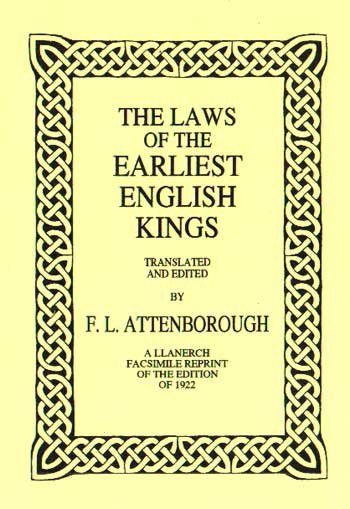
The Laws of the Earliest English Kings is a 1922 Cambridge University Press volume edited and translated by F. L. Attenborough. It brings together the earliest surviving English law codes, printing the Old English text with a facing‑page modern English translation.
The book is organised as follows:
- The Kentish laws (Æthelberht, Hlothhere and Eadric, Wihtred)
- The laws of Ine and the laws of Alfred
- Treaties with the Danes (e.g. the Alfred–Guthrum treaty)
- The laws of Edward the Elder and of Æthelstan
Attenborough omits some manuscript tables of contents and very long introductions found in certain copies, to keep the focus on the actual legal clauses.
How far back these laws go
The volume starts with the laws of King Æthelberht of Kent, the first written law code in the English language. Æthelberht ruled in the late 6th and early 7th century and was king when Augustine’s mission arrived in 597, so his code is normally dated to the early 600s.
From there, the book moves through:
- Hlothhere and Eadric (c. 670s) and Wihtred of Kent (late 7th century)
- Ine of Wessex (late 7th century, c. 688–694)
- Alfred of Wessex (late 9th century) and his treaty with Guthrum
- Edward the Elder and Æthelstan in the early 10th century
So, in one volume your readers go from roughly the first decade of the 600s through to the early 900s – about three centuries of early English royal law‑making.
What kind of “rules” are inside
Most of the material is not grand theory but very concrete rules. Typical themes include:
- Fines and wergeld (compensation tariffs) for injury and killing, graded by rank and by which body part is harmed.
- Protection of the Church and clergy, often with much heavier penalties than for the same offence against an ordinary free man.
- Rules about theft, house‑breaking, harbouring fugitives, and failing to keep the king’s peace.
- Provisions about oaths, ordeal and the procedures for proving a case.
The laws of Æthelberht, for example, are largely a tariff of fines: how much must be paid for striking someone, cutting off an ear, killing a man of a certain rank, and so on. Later codes, especially Alfred’s and Æthelstan’s, mix these compensation rules with concerns about royal authority, public order and Christian practice.
Why this 1922 book still matters
Although it is over a hundred years old, Attenborough’s edition is still regularly cited in modern work on Anglo‑Saxon law and early English legal history. For many decades it was the standard convenient English‑language source for these early codes, and even now his clause‑numbering and translations are used in legal‑historical discussion and teaching.
Its main strengths:
- It puts the core early law codes (Kentish kings, Ine, Alfred, Edward, Æthelstan) in one place.
- It gives Old English text and a facing English translation, so readers can see exactly what is in the laws.
- It has notes and indexes that help trace particular topics (for example, clauses about the Church, or specific types of compensation).
Modern scholarship has revised some dates and interpretations, and new editions and commentaries exist, but Attenborough’s 1922 volume remains a recognised reference point rather than an obsolete curiosity.
The Laws of the Earliest English Kings (F. L. Attenborough, Cambridge, 1922) brings together the earliest surviving written English law codes, from King Æthelberht of Kent in the early 7th century through to King Æthelstan in the early 10th century. It prints the Old English text with facing English translations and remains a standard source for early Anglo‑Saxon law, even though later scholarship has added new interpretations.
Read The Full Unredacted Book Or Download Your Own Copy Below: