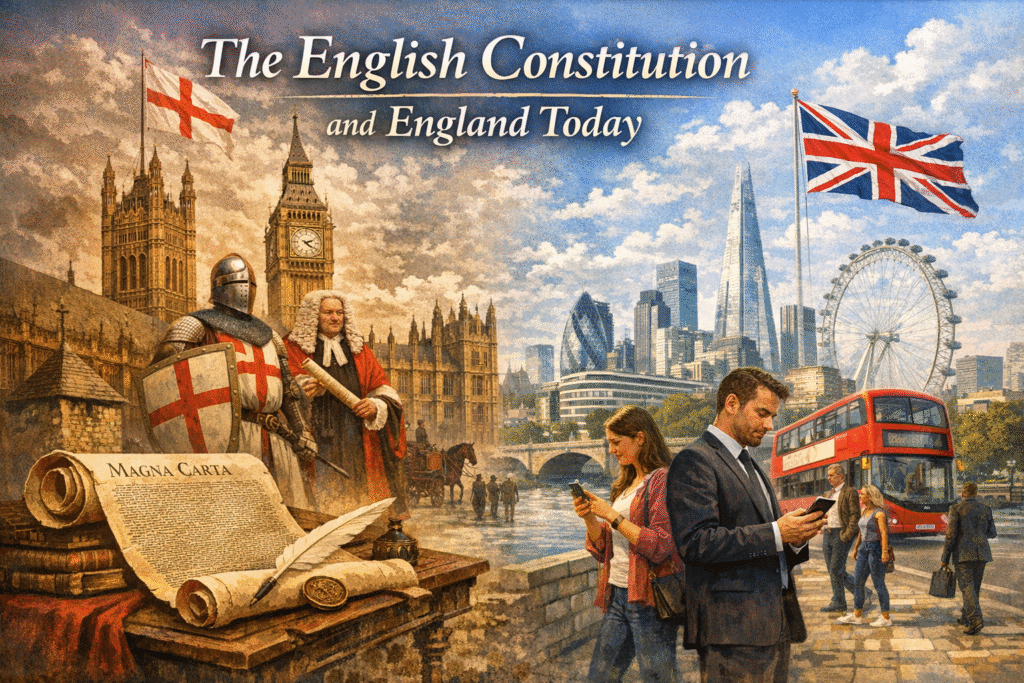
For most of its history, England had its own constitutional order: its own Parliament of England, and a set of charters, statutes and court decisions that limited power and recognised basic protections for subjects. Key landmarks included Magna Carta (first granted in 1215), which promised that no free man would be punished “except by the lawful judgment of his peers or by the law of the land”, and the Bill of Rights 1689, which declared that suspending laws without Parliament was illegal, that elections “ought to be free”, and that freedom of speech in Parliament should not be questioned in the courts.
In 1707, the Acts of Union joined the Kingdom of England (including Wales) and the Kingdom of Scotland into Great Britain, abolishing the separate Parliaments and creating a single Parliament at Westminster. Later, further union with Ireland produced the United Kingdom. Modern constitutional writing treats the earlier English texts – like Magna Carta and the Bill of Rights – and the Union Acts themselves as part of the wider UK constitutional inheritance.
Today, the UK system is usually described as based on parliamentary sovereignty: Parliament can legislate on any subject, no Parliament can bind a future one, and courts cannot strike down Acts as invalid. At the same time, some statutes – such as Magna Carta (in its surviving clauses), the Bill of Rights, the Acts of Union, the Human Rights Act 1998 and the devolution Acts – are treated in practice as “constitutional statutes” dealing with fundamental rights or the distribution of powers.
For people living in England now, this history still shows up in everyday life:
- Freedom of expression is protected through common law and Article 10 of the European Convention on Human Rights, given effect in UK law by the Human Rights Act. Article 10 states that “everyone has the right to freedom of expression”, subject to restrictions that must be lawful, necessary and proportionate for aims such as protecting national security, preventing disorder or crime, or safeguarding the rights of others.
- Trial by jury in serious criminal cases traces back to the idea in Magna Carta of judgment by “peers”. In England and Wales today, most serious offences in the Crown Court are decided by a judge and a jury of twelve citizens, although Parliament has allowed non‑jury trials in narrowly defined circumstances.
- Rule of law safeguards, such as habeas corpus and modern judicial review, reflect the long‑standing expectation that government must act according to law and that courts can examine whether detention or administrative decisions are lawful.
Taken together, these arrangements mean that older English constitutional texts and ideas still influence how power is exercised and controlled in England, even though they now operate within the framework of a British and then UK Parliament. The full page “How the English Constitution Still Shapes England Today” explores this story in more detail, from Magna Carta and the Bill of Rights to the Human Rights Act, jury trials and modern debates about what Parliament can change.