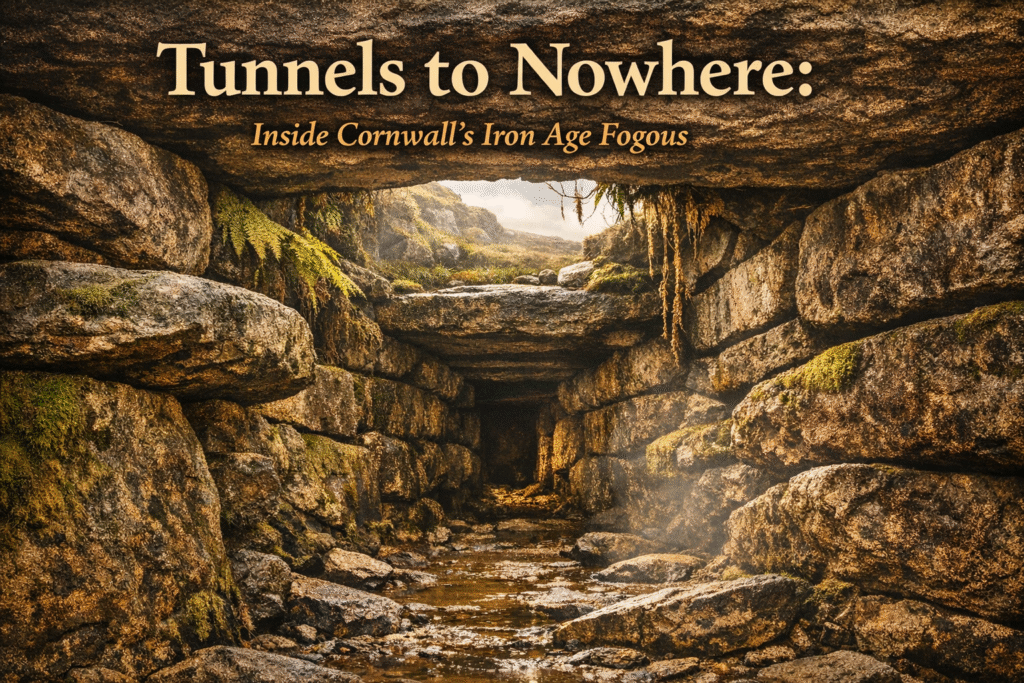
The day I ducked into the dark
The first time I stepped into one of Cornwall’s Iron Age fogous, I had that instant, primal thought: “If the torch goes out, I’m staying here forever.”
You crouch through a low stone entrance, shoulders brushing damp rock, the temperature dropping with every step. A few metres from bright Cornish fields, you’re suddenly in a long, narrow tunnel that seems to go nowhere in particular. It isn’t a mine. It isn’t a natural cave. It’s a purpose‑built underground structure, at least 2,000 years old – and we still don’t agree what it was for.
In 19 years of working around history, travel, and hidden stories, I’ve noticed something: the further back you go, the fewer straight answers you get. Iron Age fogous are a perfect example. They’re specific to this corner of England, unique in their design, and tightly connected to everyday life in ancient Cornwall – yet they refuse to fit neatly into one box.
In this article, we’ll explore what fogous are, how they were built, where you can find them, the leading theories about their purpose, and what they tell us about how people thought and lived here two millennia ago. Along the way, I’ll share some on‑the‑ground impressions you’ll never get from a textbook.
If you’re looking for more than just a quick “what is a fogou?” answer, and you want a deeper, engaging guide you can actually use – whether you’re planning a trip or writing your own content – this is for you.
What exactly is a fogou?
Let’s start simple: what are we actually talking about when we say “fogou”?
A fogou (pronounced roughly “FOH-goo”) is a stone‑built underground passage or chamber associated with Iron Age and Romano‑British settlements in Cornwall. They usually sit inside or right next to a farmstead or village and are constructed using a “cut and cover” technique: dig a trench, build stone walls, roof them with big slabs, then bury the whole thing so only a concealed entrance remains.
A few key features:
- They date roughly from around 500 BC to the early centuries AD.
- They are found almost exclusively in west Cornwall.
- Most are 10–30 metres long, sometimes with side chambers or very tight “creep” passages.
- They are not natural caves; they are engineered structures.
If you know about souterrains or earth houses in Ireland and Scotland, fogous are cousins – but with their own Cornish twist. What makes them so compelling is that they’re not isolated oddities in the middle of nowhere. They sit right inside the social and economic heart of Iron Age life: the farm, the fields, the village.
In other words, these “tunnels to nowhere” mattered enough for people to invest serious labour and skill in building them slap in the middle of where they lived.
Where to find fogous: Cornwall’s hidden underworld
For most readers, “Cornwall” brings to mind beaches, surf, and pasties – not stone tunnels under your feet. That’s part of the appeal.
There are only a dozen‑plus confirmed fogous, and they cluster in the far west. A few of the most important ones, especially if you’re planning a visit or building a content series, are:
Halliggye Fogou – the flagship
Halliggye Fogou on the Lizard peninsula is the one I recommend you start with. It’s managed by English Heritage, reasonably accessible, and a powerful introduction.
You walk through quiet farmland near the Trelowarren Estate, pass a simple entrance, and then suddenly you’re in a long, stone‑lined passage. The main tunnel is surprisingly tall in places, but the side creep is low and tight enough that you’ll feel it in your knees and your nerves.
If you’re even mildly claustrophobic, this is where you find out.
Carn Euny – a whole village around a fogou
Carn Euny, out towards Land’s End, is ideal if you want to see a wider Iron Age and Romano‑British settlement as well as a fogou. Here, you get:
- The remains of stone courtyard houses.
- A clear sense of the village layout.
- A spectacular central fogou with a side “beehive” chamber that feels almost like a stone womb.
Standing in the fogou at Carn Euny, you’re literally in the centre of the community. Above and around you, 2,000 years ago, people were grinding grain, tending animals, and raising children. You’re not in some remote ritual site; you’re inside a tunnel they chose to place at the heart of everyday life.
Other sites: a quick roll‑call
For completeness, other fogous (or possible fogous) include places like:
- Boden
- Pendeen Vau
- Boleigh
- Treveneague
Some are on private land, some are in poor condition, and some are more for specialists than casual visitors. For a first‑time explorer or an article aimed at general readers, Halliggye and Carn Euny will give you more than enough to work with.
If you’re building content, you can treat these two as your “hero” locations and mention the others in a short sidebar for keen readers.
How were fogous built – and why that matters
One of the best ways to understand an ancient structure is to imagine building it yourself with the tools available at the time.
Picture this:
- You and your neighbours dig a long trench deep into the earth with nothing more than basic iron tools, wooden shovels, and sheer stamina.
- You haul in heavy stone to build thick, dry‑stone walls along both sides.
- You lever massive capstones into place to form a roof, using timber and muscle rather than cranes or machinery.
- Then you backfill the trench, hiding your work beneath the surface, leaving only a small, controlled entrance.
This is a serious project. It’s not “we dug a storage hole behind the shed one weekend”. It’s coordinated labour from a community that doesn’t have surplus energy to waste. Whatever these tunnels to nowhere were for, they were important enough to divert time away from ploughing, herding, and staying alive.
A couple of points stand out:
- Engineering skill: These fogous have stood for over 2,000 years. Even today, stepping into one, you can feel the solidity and precision of the stonework.
- Location choice: They aren’t random. They’re integrated into settlements, often centrally placed. That suggests they were part of the mental and social fabric of the community, not an afterthought.
- Deliberate concealment: The “cut and cover” approach ensures the fogou is invisible from a distance. That is a design decision, not an accident.
When you keep those facts in mind, the big question (“What were fogous for?”) becomes much more interesting.
What were fogous used for? The main theories
This is where things get lively. Ask three archaeologists and you’ll get at least four opinions. Over the years, several main theories have emerged. None is completely satisfying on its own, and that’s part of the fun.
Cold storage and food protection
The practical explanation is straightforward: fogous were cool, dark spaces for storing food, grain, or other valuable goods. Underground spaces maintain a relatively stable temperature and protect contents from sunlight and sudden weather changes.
On the face of it, that makes sense. If you’ve ever been in a wine cellar or root store, the feel of a fogou isn’t a million miles away.
But there are problems:
- The construction is over‑engineered for basic storage.
- Access can be awkward; some tunnels are tight and low.
- If storage was the only goal, it would have been easier to build simpler pits or cellars.
My take after years of looking at these things: storage is probably part of the story, but not the whole story.
Hiding places and emergency refuges
Another popular idea is that fogous were places to hide during raids. Iron Age Cornwall wasn’t a permanently peaceful place; conflict, cattle raiding, and small‑scale warfare were part of life. A hidden tunnel where you stash your most precious items – and maybe your family – makes intuitive sense.
Again, some details fit:
- Concealed entrances.
- Underground spaces where you could keep out of sight.
- Location within defended settlements.
But ask yourself this: would you want to ride out a serious attack crouched in a long, narrow, sometimes airless tunnel with one tight way in and out? It’s not impossible, but it’s not ideal. And again, the amount of effort involved seems high for a solution that is only used in emergencies.
Ritual and ceremony
This is where things get more charged, because as soon as you say “ritual”, half the internet thinks “cop‑out explanation” and the other half thinks “great, druids and candles”.
When archaeologists talk about ritual in this context, they usually mean: these places were used for activities that marked transitions, beliefs, and identities – not just daily chores.
A few reasons ritual use keeps coming up for fogous:
- The tunnels are liminal spaces: between light and dark, above and below, in public view and hidden.
- They sit at the centre of communities, not out on the margins. It’s as if the heart of the settlement has a literal under‑heart.
- In some fogous, people have found hints of structured deposits or unusual features (like specific side chambers) that suggest organised use, not random dumping.
Ritual doesn’t exclude other uses. A fogou could be where you stash smoked meat most days of the year and also where you perform midwinter ceremonies, ancestor rites, or initiations. Think of how many churches doubled as community halls, courts, and storehouses in different periods. Spaces are rarely single‑purpose in real life.
A mix of all three
The most honest answer – and the one I find most convincing – is that fogous had multiple roles that shifted over time.
Maybe a fogou started as a prestige project and ceremonial space, then later generations used it mainly for storage. Or perhaps the community themselves never separated “practical” and “sacred” the way we tend to. You can pray for a good harvest and store barley in the same place without feeling you need two separate buildings.
From an SEO perspective, this is also a useful point: when people search “what were fogous used for?” they’re usually expecting a clean answer. Your article can stand out by clearly laying out each theory, then explaining why a blended interpretation makes the best sense.
What fogous reveal about Iron Age life
It’s tempting to treat fogous as an isolated curiosity, but they make more sense if you zoom out to the bigger picture of Iron Age Cornwall.
A few important insights:
These were settled, organised communities
We’re not dealing with small, wandering groups. The settlements connected with fogous – like Carn Euny – show long‑term occupation, structured house plans, and evidence of farming and trade. Building an underground structure at this scale requires planning, leadership, and cooperation.
People thought vertically, not just horizontally
Today we mostly live on one level: houses sit on the ground, maybe with a loft or a cellar. For Iron Age communities here, the vertical dimension mattered in a different way.
- The sky above, with its sun, moon, and stars, mattered for farming and belief.
- The earth below held mineral wealth, ancestors, and perhaps supernatural forces.
Fogous sit in that vertical imagination. They aren’t just sideways spaces; they’re portals into “down”. Whether you interpret that as a link to the dead, to deities, or to the under‑world of roots and seeds is up to you – but it’s very likely that going underground felt symbolically charged.
Fear and safety were constant themes
When you stand inside a fogou, you’re keenly aware of how protected you are – and how vulnerable. The stone around you feels safe and solid, but you’re also dependent on that small dot of light at the entrance.
Iron Age life would have been full of similar tensions: between safety and threat, known neighbours and raiding outsiders, good harvests and bad years. It makes sense that communities created spaces which literally embodied those contradictions.
From a content point of view, this is where you can bring in human detail. Instead of just “people used fogous for X”, try “imagine a family stepping down here at midwinter, carrying a lamp, while storms lash the settlement above.” This kind of framing sticks with readers.
Visiting fogous today: practical tips and personal notes
If you’re now thinking, “I want to see one,” good. Fogous are not just interesting on the page; they’re deeply memorable in person.
A few practical suggestions and personal observations:
Check access before you go
Halliggye Fogou and Carn Euny are the best starting points for most visitors. Opening times, parking, and path conditions can change with the seasons, so check a current guide or official site before you drive out. Some other fogous are on private land or are unsafe to enter; don’t assume you can just rock up and wander in.
Bring a decent light
Yes, your phone torch will technically work. But if you want to see the construction details and really feel the place, a headtorch or a small proper flashlight makes a big difference.
When I visited Halliggye, I consciously turned my torch off for a few seconds in the deeper section. That moment – when the darkness becomes almost physical – tells you more about Iron Age experience than any information board. Do it safely, of course, and only where you’re sure of your footing.
Dress for mud and low ceilings
Fogous are not polished tourist attractions. Expect:
- Muddy or uneven floors.
- Drips from the roof after rain.
- Low sections where you have to crouch or stoop.
If you’re writing travel content, don’t gloss over this. Many readers will appreciate straightforward guidance: “If you hate tight spaces, stay near the main passage and skip the creeps.”
Combine sites for a deeper day out
In content terms, this is where you can add extra value: suggest simple, realistic itineraries. For example:
- Day idea: Morning at Carn Euny, lunch in a local village, afternoon at another ancient site like a stone circle or quoits.
- Alternative: Combine a fogou visit with a coastal walk so readers get both the underground and open‑air experience in one day.
This turns your article from “interesting” to “actionable”, which is exactly the sweet spot for a really valuable post.
Conclusion: Why these “tunnels to nowhere” matter now
On paper, Cornwall’s Iron Age fogous are just old stone tunnels with disputed functions. In reality, they’re one of the most direct, physical ways you can step into the mindset of people who lived here two thousand years ago.
You’re walking through a space they intentionally hid, invested labour in, and wove into the centre of community life. You feel the same chill, hear the same echoes, and face the same basic question: “What am I doing down here?”
For me, that’s why Cornwall’s fogous deserve far more attention than they get. They’re not just “weird Celtic stuff” or a line item in a guidebook. They’re quiet challenges to how we think about the past: less tidy, less obvious, and far richer in possibility.
If this has intrigued you, here’s what I’d suggest next:
- If you’re a traveller, put Halliggye Fogou or Carn Euny on your next Cornwall itinerary. Go, crouch, listen.
- If you’re a writer or creator, think about how fogous could anchor a series on hidden England, pairing them with places like Margate’s Shell Grotto or Cold War bunkers.
- And if you’re simply curious, keep asking the question Iron Age fogous force on all of us: how much of our world – above and below ground – do we still not really understand?
FAQs about Cornwall’s Iron Age fogous
1. What is a fogou in Cornwall?
A fogou is an underground stone tunnel or chamber built during the Iron Age and Romano‑British period, mostly in west Cornwall. It’s usually found at the centre of a settlement and built with stone walls and large roof slabs, then covered over. Unlike natural caves, fogous are carefully engineered structures that formed part of everyday community life, even if their exact purpose is still debated.
2. Why are they called “tunnels to nowhere”?
Fogous are often dubbed “tunnels to nowhere” because they don’t obviously lead from one place to another, like a passage between two buildings would. Instead, they form self‑contained underground spaces, sometimes curving or looping back on themselves. To modern eyes, they seem to exist purely “for their own sake”, which is why they feel so mysterious.
3. How many fogous are there in Cornwall?
There are only a small number of confirmed fogous in Cornwall – usually counted at just over a dozen – plus a few more possible examples that are disputed, damaged, or inaccessible. Halliggye Fogou and Carn Euny are among the best preserved and easiest to visit, which is why they’re often featured in guides and research.
4. Are fogous safe to visit?
The major fogous open to the public, such as Halliggye Fogou and Carn Euny, are generally safe if you follow local guidance. They can be dark, damp, and low in places, so they’re not ideal for anyone with severe claustrophobia or mobility issues. Always bring a torch, wear sensible footwear, and avoid entering any structure that is fenced off, locked, or clearly unstable.
5. Can children visit fogous?
Yes, many families visit fogous, but it depends on the child. Some kids love the adventure of a stone tunnel; others may find it frightening. If you’re bringing children, talk to them beforehand about what to expect – darkness, low ceilings, and echoey spaces – and stay close to them while you’re inside. For many children, a short time in the main passage (without exploring the tightest side sections) is more than enough for a memorable experience.