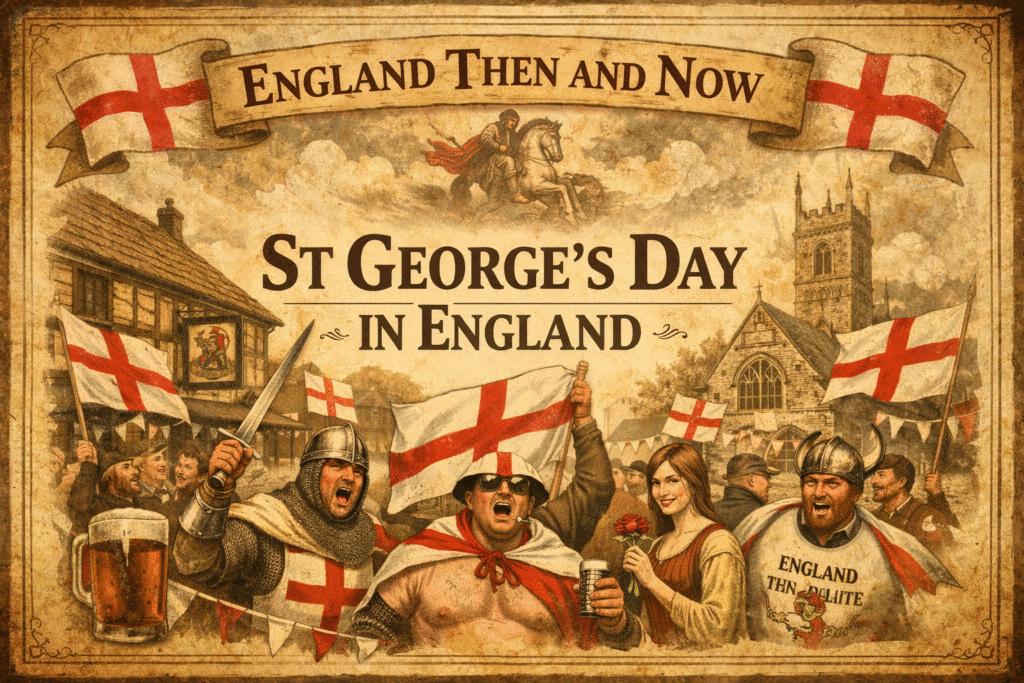
Every St George’s Day the same idiots show up. You know exactly who I mean. The people who only mention England to sneer at it, who crawl out once a year to tell you “he wasn’t English”, “he never even visited England”, or now the latest genius take: “Restore would have deported him, he’d be an illegal immigrant.”
In this article I want to do two things. First, arm you with real history so you can knock that nonsense flat. Second, use St George’s Day to make a bigger point about English identity, national days, and why we’re absolutely entitled to our own stories and symbols.
Every St George’s Day the same idiots show up
Every St George’s Day the same idiots show up. They don’t know much history, but they’re very loud online.
You’ve seen the pattern:
- “He wasn’t English.”
- “He never visited England.”
- “He’d be an illegal immigrant today.”
- “Restore would deport him.”
It’s always the same tone – smug, superior, and allergic to anything that looks like English pride. They’re not making a serious historical point; they’re trying to wind you up and shame you out of flying your own flag.
Here’s the problem for them: when you actually look at the facts, their whole argument collapses in about thirty seconds. And once you understand that, you stop getting defensive and start treating them like what they are – people who don’t know their own country’s history, trying to lecture you on it.
Who St George actually was (and why that matters)
Let’s get the basic biography out of the way, because this is where they think they’ve got you.
No, St George was not “English” in the way we’d use that word today. He almost certainly came from Cappadocia – roughly modern-day Turkey – inside the eastern half of the Roman Empire. He was a professional soldier, an officer, and a Christian at a time when that was a dangerous combination.
The traditional story is simple: he served in the Roman army, refused to renounce his Christian faith under Emperor Diocletian, and was executed around the year 303. He’s venerated as a martyr because he chose faith and conscience over obeying an unjust order.
A few points that matter here:
- He lived and died inside the Roman Empire – he wasn’t sneaking across borders in the back of a lorry.
- His “crime” was refusing to bow to state persecution, not breaking immigration rules.
- The famous dragon story is a later legend – a symbol of good overcoming evil – not a wildlife documentary.
So yes, the online geniuses are technically right on two facts: he wasn’t English, and he never visited England. But they stop there because they don’t understand what a patron saint is, or how national symbols work.
How a Cappadocian soldier became England’s patron
The real story – the one they never mention – is how England deliberately chose St George and made him ours.
Patron saints aren’t assigned by DNA. Nations, cities and professions pick figures whose story resonates with them. Virtues, not passports. That’s how you end up with:
- St Patrick as the patron of Ireland, even though he was born in Roman Britain.
- St Andrew as patron of Scotland, despite being a Middle Eastern apostle who never set foot anywhere near Fife.
- St Nicholas (yes, that one) as patron of places from Bari to Amsterdam, despite spending his life in what’s now Turkey.
England is no different. St George’s cult spreads through the Christian world. His story of courage under persecution speaks loudly to soldiers and kings in a Europe that’s constantly at war.
In England:
- His feast day is being marked here by the early Middle Ages.
- Crusaders and pilgrims bring home stories, images and devotions associated with him.
- English kings start putting his cross – a red cross on white – on their banners.
By the time you get to the 14th century, Edward III isn’t picking him at random. He builds the Order of the Garter around St George. The red cross becomes strongly linked to English armies and English identity. For centuries after that, English soldiers go into battle under his flag.
That’s the bit your “he wasn’t English” brigade never mention: the conscious, repeated choice by English kings and English people to say, “That man, that story, that cross – that represents us.”
Patron saints, nations and the point everyone is missing
This is where the whole “he wasn’t English” line just falls apart.
A patron saint is not a genetic claim. Nobody is saying St George was born in Kent and went to school in Winchester. A patron saint is a symbol. A banner. A story you choose to stand under.
If you strip away all the noise, the St George story England adopted is about three things:
- Courage – standing firm when it costs you.
- Conscience – refusing an order you know is wrong.
- Victory of good over evil – the dragon legend is a picture of that.
Now ask yourself: is there anything “un-English” about choosing those virtues as your national emblem?
What the anti-English crowd are really doing is policing your symbols while pretending to be clever. They know full well that most national days, flags and saints are symbolic, not literal. They’re not really upset that St George wasn’t English. They’re upset that you’re still allowed to feel English.
Every St George’s Day the same idiots show up because they’re running the same script:
- Pick at a surface-level “gotcha” (“he wasn’t English”).
- Use it to imply you’re thick or racist for flying your own flag.
- Hope you back down and shut up.
Once you see that pattern, you stop engaging on their terms. You don’t have to justify flying your own flag to people who don’t believe the English are allowed to exist as a nation in the first place.
“He’d be an illegal immigrant today” – no, he wouldn’t
Now we get to the modern twist: the “illegal immigrant” meme and the “Restore would deport him” joke.
Let’s be blunt: this is historical illiteracy dressed up as political banter.
Take St George as he actually was:
- A Roman citizen.
- Serving in the Roman army.
- Operating inside the borders of the Roman Empire as a state official.
By any honest standard, that’s not an illegal migrant. That’s a government employee. The issue in his story isn’t where he crossed a border; it’s that he refused to bow to religious persecution.
Trying to map 3rd‑century Roman internal movement onto 21st‑century British immigration law is like asking whether Boudica had a TV licence. It doesn’t make you edgy. It makes you look clueless.
And on the Restore angle:
- Restore’s talk is about deporting people who enter or stay in the UK contrary to modern law.
- St George, as described in the tradition, doesn’t even fit the category. Wrong era, wrong system, wrong legal framework.
If someone wants to make a joke meme, fine. But when they start using that meme as a stick to beat ordinary English people with – “see, your own patron saint would be deported!” – that’s when it stops being harmless and starts being yet another way to delegitimise English identity.
You don’t have to defend any modern party to say this: if your entire political analysis boils down to “man from ancient Cappadocia equals today’s illegal migrant”, you’re not serious.
The deeper question: who gets to decide what England is?
Every St George’s Day the same idiots show up, but there’s a deeper fight underneath the memes. It’s about who gets to define England.
On one side you’ve got normal people who:
- Like seeing the flag out on 23 April.
- Want their kids to know basic English history.
- Feel instinctively that England is a real nation, with a real story, that deserves better than being treated as a punchline.
On the other, you’ve got two noisy extremes:
- The anti-English types who think any sign of English pride is dangerous and must be mocked into silence.
- The shallow culture warriors who treat St George purely as a marketing logo while ignoring the substance – conscience, courage, resistance to unjust power.
Both of those are useless.
The English tradition is actually richer and more demanding than either side admits. The same culture that chose St George also produced Magna Carta, jury trials, limits on arbitrary power, and a long suspicion of rulers who think they’re gods. That’s not “far right”, that’s our inheritance.
St George fits that tradition perfectly: a man who served the state loyally until the state ordered him to betray his conscience. Then he said no, and he paid the price. You don’t have to share his faith to understand the principle.
That is a better model for Englishness than any party political slogan: serve honestly, obey the law – and when power crosses a moral line, stand your ground.
What St George’s Day should mean for the English now
So where does that leave you, the ordinary English person who’s sick of being told you’re not allowed to be proud of your own national day?
Here’s what I think St George’s Day should be about in 2026:
- Permission – the simple permission to be openly English, to fly your flag, to mark your day, without having to apologise to people who only remember England exists when they want to sneer at it.
- Memory – teaching your kids and grandkids who St George actually was, why his flag is on our shirts, and how England became a nation long before most of today’s critics were even thought of.
- Standards – using the story as a reminder that the English idea of loyalty has always been conditional: loyalty to law, to conscience, to higher principles, not blind obedience to whoever happens to be in office.
Every St George’s Day the same idiots show up. Let them. They can’t stop you putting your flag up. They can’t stop you telling the truth about your own history.
The only way they win is if you shut up and sit down.
Conclusion: Fly the flag, tell the truth
St George wasn’t “English” in the modern ethnic sense. He didn’t walk the streets of London. He would have had no idea what “England” even was.
And yet, for centuries, English kings and English people have chosen his story as a banner to stand under – courage, conscience, good over evil. That’s what a patron saint is. That’s how symbols work.
Every St George’s Day the same idiots show up with the same lines. You don’t beat them by going quiet. You beat them by knowing the history better than they do, by refusing to be shamed out of your own identity, and by passing that identity on to the next generation.
So this year, don’t just roll your eyes at the comments. Put the flag up. Tell the story. Talk about England – our dates, our laws, our constitution, our heroes and our failures.
Because if we don’t tell that story, the people who hate this country will happily tell it for us.
FAQs about St George’s Day and English identity
1. Was St George actually English?
No. St George was probably born in Cappadocia (modern Turkey) inside the Roman Empire and served as a Roman soldier. England adopted him later as a patron saint because his story of courage and martyrdom resonated with English kings and people, not because of where he was born.
2. How did St George become the patron saint of England?
His cult spread through the Christian world, especially among soldiers. In England his feast day was already being celebrated in the early Middle Ages. Later, kings like Edward III deliberately promoted him, built orders of chivalry around him, and used his red cross on their banners. Over time he became firmly associated with England.
3. Does it matter that he never visited England?
Not for his role as patron saint. Patron saints are chosen for what they represent, not their travel history. St Patrick wasn’t Irish by birth, St Andrew never visited Scotland. What matters is that the English consciously chose St George’s story and symbol to represent national virtues.
4. Would St George be an “illegal immigrant” today?
No. In his own time he was a Roman citizen and army officer operating within the Roman Empire. The modern concept of “illegal immigration” under UK law simply doesn’t map onto a 3rd‑century Roman context. Comparing him to modern illegal entrants is a meme, not serious history.
5. Why do “the same idiots” always attack St George’s Day?
Because St George’s Day is one of the few moments when ordinary English identity comes into the open. For people who dislike the idea of England as a real nation, mocking the patron saint and the flag is a way to undermine that identity. They hide behind shallow historical “gotchas” to make you feel embarrassed about being openly English. You’re under no obligation to play along.