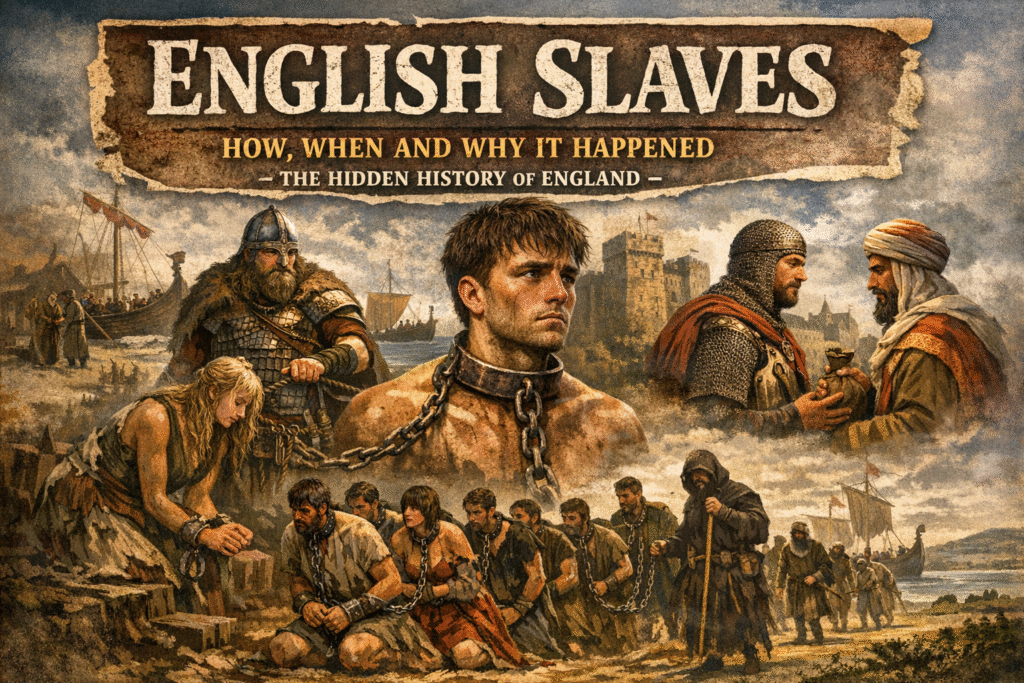
The Forgotten Story of English Slaves
Most people in England know something about the Atlantic slave trade and enslaved Africans in the Caribbean and Americas. Very few realise that English people themselves were slaves at different points in history – both inside England and after being carried away from English coasts.
In this article, I’ll walk you through the factual record:
- when English slavery existed,
- how English people became slaves,
- where they were taken from and to,
- and rough estimates of how many were affected.
I’ll keep to evidence you could trace back to documents, court records, official surveys, and modern historical research. Think of this as a clear, fact‑focused guide to a part of England’s story that almost no one is taught in school.
You’ll see the phrase “English slaves” used a few times – not as a slogan, but as a historical description based on legal status and contemporary sources.
Slavery Inside England: Before and Just After 1066
The first thing to understand is that slavery in England is not just something that happened “out there” overseas. For centuries, it existed inside England itself.
Legal status: the theow
In Anglo‑Saxon England (before the Norman Conquest in 1066), society recognised several legal groups: nobles, free peasants, unfree peasants, and slaves. Slaves were often called theows in Old English.
Key factual points:
- A theow was legally unfree and could be bought and sold as property.
- Laws from Anglo‑Saxon kings (such as King Æthelstan and others) include rules about the sale, punishment and treatment of slaves.
- Slaves could not freely leave their masters and had no independent legal standing in the way free people did.
In plain English: if you were a slave in 10th‑ or 11th‑century England, you were owned.
The Domesday Book and the 10% figure
After William the Conqueror took England in 1066, he ordered a great survey of land and people, completed in 1086: the Domesday Book. It records, among other things, how many slaves were present in different places.
From that survey:
- Over 10% of the recorded population of England were listed as slaves in 1086.
- In some areas, the proportion was higher; in others, lower, but slavery was spread across large parts of the country.
That means that in late 11th‑century England, more than one in ten people were legally in a slave class. This is a hard statistical anchor: it comes from a near‑contemporary state survey, not later guesses.
How English people became slaves in England
The records and laws show several ways an English person could become a slave:
- War captives: Defeated enemies could be taken as slaves.
- Crime: Some crimes could result in a person being reduced to slavery as punishment.
- Debt: A person unable to pay debts might sell themselves or family members into slavery.
- Birth: Children born to slaves were often themselves slaves.
If you picture an English village around the year 1000, you are not looking at a community of “all free villagers”. You are looking at a mix: some fully free, some bound as serfs, and a substantial minority who are properly described as English slaves.
The End of Slavery in England and the Shift to Serfdom
Slavery inside England did not last in the same form forever. Over time, it changed into a different kind of unfreedom – serfdom or villeinage. This matters because it marks the end of English people being bought and sold as straightforward chattel within England itself.
William I’s ban on exporting English slaves
After 1066, William I (William the Conqueror) issued a law forbidding the export of English slaves abroad. This tells us two things:
- English people were being exported as slaves before his ban.
- The Crown felt the need to stop that trade, at least officially.
It does not mean slavery vanished overnight, but it is a clear policy line: English bodies were not to be shipped out and sold in foreign markets.
The 12th‑century change
By the middle of the 12th century, sources indicate that slavery as a formal institution inside England had largely disappeared. Instead, the main unfree status was villeinage (serfdom):
- Villeins were tied to a manor and a lord.
- They owed labour obligations and various dues.
- They were not “free” but were no longer typically bought and sold as individual portable property in the same way slaves had been.
In other words, unfreedom didn’t vanish – but the specific category of “slave” faded from English law and practice.
From this point onward, when we talk about English slaves, we are mostly talking about English people who were taken out of England and enslaved elsewhere.
English Slaves of Barbary Pirates: Raids on England’s Coasts
Several centuries after slavery faded inside England, English people again became slaves – this time captured by Barbary corsairs from North Africa. This is the part of the story that shocks most modern readers when they first encounter it.
Who were the Barbary pirates?
“Barbary pirates” or “Barbary corsairs” were raiders based in ports along the Barbary Coast of North Africa, such as Algiers, Tunis, Tripoli and later Salé. They operated from the late 1500s into the 1700s.
Their aims were simple and brutal:
- Capture ships and cargo.
- Seize people – men, women and children – to sell as slaves or keep for forced labour.
These captives were mainly Christian Europeans, which included large numbers of English people.
English coasts at risk
For English readers, the crucial point is this:
- The south‑west of England, especially Cornwall and Devon, was repeatedly attacked over roughly 300 years.
- Barbary corsairs sailed up the Channel and the western approaches, raiding English shipping and in some cases landing directly on English shores.
Specific documented English cases include:
- Mount’s Bay, Cornwall (St Michael’s Bay), August 1625: Barbary raiders landed, attacked local settlements and took around 60 English men, women and children. These people were carried off to North Africa to be sold as slaves.
- St Keverne and nearby Cornish communities, 1626: The pirates repeatedly raided the area; boats from Looe, Penzance, Mousehole and other villages were found adrift, their crews already carried away into captivity.
- Cornish coast, 1645: Another large raid took roughly 240 English people – again a mix of men, women and children – from coastal settlements.
Alongside these landings, hundreds of English merchant and fishing vessels were taken at sea, and their crews were enslaved.
Official records from England
This wasn’t just rumour in taverns; it shows up in formal English documents. For example:
- In May 1625, a government report to the English authorities stated:“The Turks are upon our coasts. They take ships only to take the men to make slaves of them.”
- Period petitions from English fishing villages asked the king for protection and for help raising money to redeem neighbours carried off into slavery.
- The Grand Remonstrance of 1641 – a major English parliamentary document – specifically complained that Barbary pirates of the Ottoman Empire were seizing English people and holding them in bondage.
- In 1640, Parliament established a “Committee for Algiers” to coordinate efforts to ransom English captives.
Those are English political and legal sources acknowledging that their own subjects were being enslaved abroad.
Numbers and Estimates: How Many English Slaves Were There?
When we talk about “English slaves” in this Barbary context, we need to be honest about what we can and cannot count. Records are patchy, but there are responsible estimates.
Losses at sea
Between 1609 and 1616, official and commercial records suggest that:
- England lost around 466 ships to Barbary pirates.
- Many of these vessels were taken with their crews alive, who were then transported to North Africa and sold as slaves or used as forced labour.
That figure alone gives a sense of how exposed English seafarers were.
Total English captives
Modern historians looking at English, Algerian and other archival material estimate that:
- Between the late 1500s and early 1700s, thousands of people from the British Isles were taken and enslaved in North Africa.
- Because a large proportion of raids and captures involved English ports and English‑flag ships, a significant share of those captives were English.
Some published estimates put the total number of British captives (English, Welsh, Scots, Irish) in the tens of thousands over the period. For example:
- One widely‑cited figure suggests the Barbary corsairs might have taken up to around 25,000 Britons in total across two to three centuries.
- Parliamentary reports in the 17th century talk of thousands of English subjects being held in Algiers at any one time, with one estimate reaching roughly 5,000 captives there.
Because records rarely separate “English” from “Scottish” or “Irish”, we cannot give a precise English‑only number, but it is historically safe to say:
- Several thousand English men, women and children were enslaved in North Africa during the height of Barbary raiding.
In addition to that:
- Inside England itself in 1086, over 10% of the English population were legally slaves, as recorded in the Domesday Book.
Taken together, that means that at more than one stage in history, being an “English slave” was a real status, not a modern invention.
Life and Death as an English Slave Abroad
Once English captives arrived in North African ports like Algiers or Tunis, they entered established slave markets and labour systems.
Types of work imposed on English slaves
Contemporary accounts from former captives and observers describe several forms of forced labour:
- Galley slaves: Many English men were chained to the benches of oared galleys, rowing long hours under harsh conditions.
- Heavy labourers: Some were sent to quarries, harbour works or construction sites.
- Skilled artisans: English captives with valuable skills (carpentry, metalwork, navigation) could be used for specialised tasks.
- Domestic slaves: Men and women could end up in households, performing domestic work.
This mixture depended on the slave markets’ needs and on the individuals’ abilities.
Living conditions
Descriptions of slave pens (bagnios) in Algiers and other ports frequently mention:
- Overcrowded sleeping spaces on stone floors.
- Chains and irons.
- Poor rations and disease.
- Regular corporal punishment, including the bastinado (hanging a person upside‑down and beating the soles of their feet).
Some English slaves were forced to convert religion or faced pressure to do so. Those who converted sometimes gained more rights or joined corsair crews, but they remained cut off from their former English lives.
Ransoms and returns
Ransom was one of the few paths out. English churches and local communities often raised funds to buy back captives:
- Collections were taken in English parishes.
- Fishing communities in places like Cornwall and Devon pooled money to redeem neighbours.
- The English envoy Edmund Cason, sent in the 1640s, paid about £30 per man (women were usually more expensive to redeem) and secured the release of roughly 250 English captives before funds ran out.
Many English captives, however, were never redeemed and simply disappear from the English records – either dying in captivity or remaining in North Africa for life.
English People in Other Harsh, Forced‑Labour Systems
While we often reserve the word “slave” for legally chattel status, it’s worth noting other systems in which English people ended up in extreme, compulsory labour.
Penal transportation
From the late 1500s onward, English law allowed:
- Some criminals sentenced to death to have that sentence commuted to transportation overseas.
- These transported convicts were forced into years of compulsory labour in colonies (for instance, in the Americas).
Although the legal language distinguished this from slavery, the lived reality for many transported English convicts was:
- Loss of freedom of movement.
- Physical punishment.
- Being “sold on” in effect via contracts, to plantation owners or colonial masters who controlled their labour for long terms.
This is not the same as chattel slavery, and historically we should be precise. But if your aim is to chart how English people ended up in brutally unfree labour conditions, then penal transportation is part of the broader picture.
What “English Slaves” Means in Historical Terms
To summarise the factual ground for the phrase “English slaves: how, when and why it happened”:
- How
- Inside England: through war, crime, debt and birth into a slave family, as recognised by Anglo‑Saxon and early Norman law.
- From England to North Africa: through sea capture and coastal raids by Barbary pirates seeking people to sell or use as slaves.
- When
- Inside England: slavery is clearly documented up to the late 11th century, with over 10% of the population recorded as slaves in 1086, and is effectively gone by the mid‑12th century.
- From English coasts: Barbary raids intensify from the late 1500s, peak in the 1600s (especially 1620s–1640s) and decline into the 1700s as English naval power grows.
- Why
- Economic reasons dominate: slaves were valuable as property and labour, whether on English estates in the 11th century or in North African cities and ships in the 17th century.
- In both cases, English people became slaves because systems existed that treated human beings as commodities and because they were vulnerable – either as the poorest in English society or as exposed coastal and maritime communities.
Across different periods, the target keyword “English slaves” is not only a dramatic phrase but an accurate historical description: English people have repeatedly been placed in slave status under the law or under foreign power.
Conclusion: Bringing England’s Hidden History Back Into View
If you grew up in England, you were probably taught about empire, industrialisation, perhaps Trafalgar or the Blitz. You were unlikely to be told that:
- Over one in ten people in 11th‑century England were slaves, as a matter of record.
- English kings had to ban the export of English slaves.
- For generations, coastal families in Cornwall, Devon and elsewhere feared Barbary raiders would carry them off into slavery in Algiers or Tunis.
These facts do not cancel any other history. They simply show that “English slaves” are part of England’s own story.
If you found this surprising, consider this your starting point. Look up the Domesday Book entries on slaves, read accounts of the Barbary corsairs, and share this history with others. The more people know the full story of England – including the times when English people themselves were enslaved – the more grounded our conversations about the past will be.
If you run a blog, podcast, classroom, or local history group, I encourage you to bring this topic into the conversation and give English readers the facts that have been missing from the usual story.
FAQs About English Slaves and English Slavery
1. Were English people really slaves, or just serfs?
Yes, English people were genuinely slaves, especially before and just after 1066. The Domesday Book lists more than 10% of the population as slaves in 1086. Serfdom (villeinage) became more common later, but slavery as a distinct status is clearly recorded in early medieval England.
2. When did slavery end inside England?
Slavery as a formal institution inside England effectively ended by the mid‑12th century. William I banned the export of English slaves, and over the next decades the category of “slave” faded into broader unfree peasantry (serfdom). Legal debates in later centuries often treated England as “free soil”, but that was not true in the 10th–11th centuries.
3. How were English people captured by Barbary pirates?
Barbary corsairs attacked English merchant and fishing ships at sea and, in some cases, landed on English shores. They seized crews and coastal villagers, particularly in Cornwall and Devon, and carried them to North Africa to be sold or used as slaves. Raids are documented in places like Mount’s Bay and St Keverne in the 1620s and 1640s.
4. How many English people were enslaved by Barbary pirates?
We do not have a precise English‑only figure, but thousands of people from the British Isles were taken in total, and England supplied many of those captives. Parliamentary reports speak of thousands of English subjects in captivity in Algiers at any one time; modern estimates suggest tens of thousands of Britons over roughly two centuries, with a significant share from English coasts and ships.
5. Why is the history of English slaves so little known today?
There are several factual reasons. Slavery inside England ended centuries ago, and the Barbary raids mainly affected particular coastal and maritime communities. As naval power grew and the threat disappeared, the fear faded from everyday English life. Later national stories have focused more on England as an imperial power and on other aspects of slavery, leaving the experience of English slaves largely forgotten in mainstream education and public memory.