There is a question that sits at the heart of post-war English history, and it has never been properly answered: How did England go from a nation that was 99% ethnically homogeneous in 1945 to one of the most demographically transformed countries in Europe by 2025?
The standard narrative is simple. Caribbean workers arrived to help rebuild Britain after the war. Successive waves of immigration followed. It just “happened” – a natural consequence of empire, labour shortages, and Commonwealth ties.
But the documentary evidence tells a different story. One that reveals a pattern so consistent, maintained across so many decades by both major parties, that the question of intent becomes unavoidable.
This article examines that evidence. It presents two interpretations – incompetence versus deliberate planning – and lets the facts speak for themselves.
The Contradictory Policies That Started It All (1945-1970)
Britain emerged from World War II in 1945 facing catastrophic labour shortages. Approximately 450,000 people had been lost during the war. Every industry – factories, transport, construction, healthcare – needed workers desperately. The country required rebuilding from the ground up.
The Attlee Labour government’s response was to facilitate the departure of British workers on an extraordinary scale.
In 1945, they partnered with Australia to launch the Assisted Passage Migration Scheme – the “Ten Pound Poms.” For £10 (approximately £441 in today’s money), British citizens could emigrate to Australia, with children travelling free. By 1947, over 400,000 Britons had registered. Over the next 27 years, more than one million working-age British citizens emigrated to Australia under this government-facilitated programme. At its peak in 1969, over 80,000 people left in a single year.
During the worst labour shortage in modern history, the government actively helped over a million workers leave the country.
The same government’s reaction to the Empire Windrush arriving at Tilbury Docks on 22 June 1948 was not gratitude but alarm. The ship carried 1,027 passengers, 802 from the Caribbean. Declassified documents show officials were concerned about “the prospect of a visibly different population,” though they assumed these would be temporary visitors rather than permanent settlers.
These were not invited workers. They were British subjects exercising an existing legal right to enter Britain – a right held for generations by virtue of birth in British colonies. The passengers had paid £28 each (roughly £1,000 today) for commercial passage, responding to advertisements in Jamaican newspapers. The shipping company had been given permission to fill the Empire Windrush with fee-paying commercial passengers in addition to military personnel.
The government simultaneously facilitated the exit of British workers while expressing alarm about the arrival of Commonwealth citizens exercising their legal rights. This contradiction is fundamental to understanding what followed.
Why Caribbean Workers Could Not Go to Australia
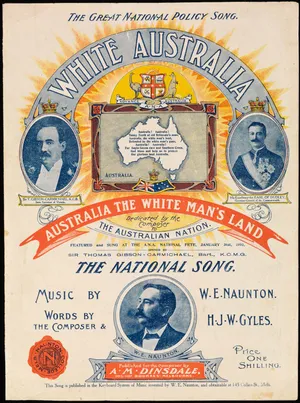
Australia operated the White Australia Policy from 1901 to the early 1970s. This was not informal preference. It was codified law specifically designed to exclude non-white immigration.
The Immigration Restriction Act gave officers power to require any non-European migrant to sit a 50-word dictation test in any prescribed language – deliberately designed to fail non-white applicants. The policy was explicit: keep Australia white and British.
Australia’s Immigration Minister Arthur Calwell stated in 1946: “Australia hopes that for every foreign migrant there will be ten people from the United Kingdom.” By 1947, only 2.7% of Australia’s population was born outside Australia, Ireland, or the United Kingdom.
The British government knew this. They cooperated fully with a scheme that required racial exclusion.
Caribbean workers who were legally entitled to live in Britain had no alternative Commonwealth destination. Australia would not accept them. Canada operated similar preferences. South Africa had its own exclusions.
Whether by design or accident, the structure created a funnel: British workers emigrated under government facilitation to destinations that practised racial exclusion. Commonwealth workers with nowhere else to go exercised their right to settle in Britain.
The pattern was set.
The Case for Unplanned Incompetence
The charitable interpretation is straightforward: the British government stumbled into demographic transformation through short-sighted, uncoordinated decisions.
No declassified documents from the 1945-1951 Attlee government show a planned demographic policy. The National Archives contain extensive post-war planning documentation – new towns, housing reconstruction, welfare state design – but nothing indicating intent to transform England’s ethnic composition.
The government’s alarm at Windrush appears genuine. They had not invited these workers. When Caribbean migration began, it was organic – people exercising existing rights as British subjects, not responding to government recruitment.
The British Nationality Act 1948, which came into force on 1 January 1949, was not about immigration. It reorganized existing British subject status, creating the category “Citizen of the United Kingdom and Colonies.” This concerned Commonwealth structure, not migration policy.
Both Conservative and Labour governments maintained the same approach for decades. If this was Labour ideology, why did Conservatives continue it when they returned to power in 1951, 1970, and 1979?
The incompetence theory holds that the government facilitated emigration to support Australia as a Commonwealth partner, failed to anticipate the severity of domestic labour shortages, then pragmatically recruited from available Commonwealth labour pools when European recruitment proved insufficient.
Cock-up, not conspiracy.
The Case for Deliberate Planning
The timeline undermines the incompetence theory at every stage.
1945-1947: Government facilitates mass British emigration to Australia despite acute post-war labour crisis.
1948: Windrush arrives. Government expresses alarm but takes no action to restrict Commonwealth immigration rights that all parties know exist.
1949: NHS begins advertising in Caribbean nursing press. Senior British nurses visit Commonwealth countries. The Ministries of Health and Labour work with the Colonial Office to recruit from colonies. NHS nursing vacancies that year: 54,000.
1956: London Transport begins direct, organized recruitment from the Caribbean at the invitation of the Barbados government. British Rail launches similar schemes. These programmes run until 1970.
1969: Peak year of the Ten Pound Poms scheme – over 80,000 British citizens emigrate to Australia while Caribbean recruitment continues at scale.
At every decision point where the government could have stopped Commonwealth immigration or restricted British emigration, they did neither. Both major parties maintained identical policies across multiple changes of government.
The government never attempted to balance emigration numbers against domestic labour requirements. They never restricted Commonwealth immigration despite mounting public concern throughout the 1950s and 1960s. They never questioned whether facilitating the departure of over a million British workers during a labour shortage served national interests.
And there is proof that deliberate demographic policy existed later.
In 2009, Andrew Neather, a speechwriter for Tony Blair, Jack Straw, and David Blunkett, revealed that from 2000 onwards mass immigration was deliberate government policy with a “driving political purpose: that mass immigration was the way that the Government was going to make the UK truly multicultural.”
Documents obtained under Freedom of Information showed these political objectives were deliberately removed from published versions.
Barbara Roche, Immigration Minister in 2000, gave a speech advocating liberalized immigration not merely for economic reasons but to “emphasize ethnic diversity.” Net immigration between 1997 and 2010: 300,000 from the Old Commonwealth, approximately one million from the New Commonwealth.
If New Labour deliberately concealed demographic objectives in 2000, the question becomes: was this the first time, or merely the first time we have documentary proof?
The Fabian Society, which heavily influenced Labour policy, advocated internationalism and opposed nationalism throughout this period. Both parties benefited politically – Labour gained reliable voting blocs, Conservatives gained cheap labour for industry.
The effect was identical regardless of stated intent: English workers were replaced by Commonwealth workers. The demographic composition of entire cities transformed within a generation.
How This Transformed English Towns and Cities
The change was not gradual integration. It was wholesale replacement.
London crossed the threshold in the 2011 census. White British people became a minority in their own capital for the first time in recorded history. Leicester, Birmingham, Luton, and Slough followed. Bradford, Oldham, and Blackburn saw similar transformations.
Entire neighbourhoods changed completely within a single generation. Schools that taught exclusively English children in 1970 had classrooms where English was a minority language by 2000.
The settlement patterns were not random. London Transport housed recruited Caribbean workers in specific areas. The NHS placed recruited nurses in particular hospitals. Local authorities used housing allocation powers to settle immigrant families in certain boroughs.
Migration Watch UK documented that between 1997 and 2010 alone, net immigration exceeded 2.2 million people. The Migration Observatory at Oxford University confirmed UK population growth from approximately 57 million in 1990 to over 67 million by 2020, with the majority attributable to immigration and births to foreign-born mothers.
These are English market towns, industrial cities, and communities fundamentally transformed in character, culture, and demographics within living memory.
This did not happen to England. It was done to England.
The Unanswered Questions
Certain questions remain without adequate documentary answers:
Why facilitate emigration during labour shortage? No government document explains this contradiction. If workers were needed desperately, why help over a million leave?
Why not restrict Commonwealth immigration once the pattern emerged? By the 1960s, significant demographic change was obvious. The government could have amended British subject status or Commonwealth immigration rights. They chose not to, despite sustained public pressure and Enoch Powell’s interventions.
Why did both parties maintain identical policies for seven decades? If this was Labour ideology, Conservatives had multiple opportunities to reverse course. They never did. This suggests either cross-party consensus or constraints not admitted publicly.
Where are the planning documents? Government departments document everything. Where are the internal discussions about balancing emigration against immigration? Where are the demographic projections? Were they destroyed? Do they remain classified?
Why the secrecy? The Andrew Neather revelations prove New Labour deliberately concealed political objectives behind immigration policy. What else has been concealed? What discussions happened behind closed doors that never reached public view?
The most troubling possibility is straightforward: both major parties recognized that mass immigration served their institutional interests. Labour gained voting blocs. Conservatives gained cheap labour and could claim economic growth through population expansion. The interests of ordinary English people did not factor into the calculation.
This is what the term “Uni-Party” means. On the question that mattered most – national sovereignty, demographic composition, cultural continuity – there has been no meaningful choice at the ballot box for 80 years.
Conclusion
The facts exist in the documentary record. Two interpretations fit those facts with varying degrees of evidence.
Was it coincidence that Britain facilitated the exit of over a million white British workers while simultaneously creating conditions that necessitated Commonwealth immigration? Was it bureaucratic oversight that this pattern continued for seven decades across multiple governments of both parties?
Or was this the deliberate transformation of England’s demographic character, pursued by a political class that never sought permission and never admitted intentions until Andrew Neather’s 2009 revelation made partial admission unavoidable?
The truth likely contains elements of both. Some decisions were incompetent. Others were almost certainly deliberate. What the Neather documents prove beyond dispute is that demographic engineering has been official policy, concealed from public knowledge.
What is not disputed is the result. England has been fundamentally transformed in ways never put to democratic vote, never honestly debated in Parliament, never explained to the English people whose country it is.
The National Archives hold the documents. The demographic data for every English town is public record. The parliamentary debates are preserved. The evidence is there for anyone who looks.
The question is whether enough people will look, and whether they will demand answers while those answers still matter.
Frequently Asked Questions
Were the Windrush passengers invited by the British government?
No. The Empire Windrush passengers were never formally invited by the government. They were British subjects exercising existing legal rights to enter Britain. The shipping company advertised affordable tickets in Jamaican newspapers. Passengers paid £28 each for commercial passage. When the government learned the ship was coming, declassified documents show they were alarmed, not welcoming.
When did active government recruitment of Caribbean workers begin?
The Windrush arrived in 1948 without government invitation. Active official recruitment began later. The NHS started advertising in Caribbean nursing press in 1949. London Transport began direct Caribbean recruitment in February 1956, starting in Barbados. Similar schemes were run by British Rail and the NHS, continuing until 1970.
Why could Caribbean workers not emigrate to Australia instead?
Australia operated the White Australia Policy from 1901 to the early 1970s, specifically excluding non-white immigration. Australia wanted white British migrants only. Immigration Minister Calwell stated in 1946: “Australia hopes that for every foreign migrant there will be ten people from the United Kingdom.” This racial exclusion meant Caribbean workers had no alternative Commonwealth destination.
Is there proof that New Labour deliberately planned demographic change?
Yes. In 2009, Andrew Neather, a speechwriter for Blair, Straw and Blunkett, revealed that from 2000 onwards mass immigration was deliberate government policy with a “driving political purpose: that mass immigration was the way that the Government was going to make the UK truly multicultural.” Documents obtained under Freedom of Information showed these political objectives were deliberately removed from published versions to avoid public controversy.
How many British people emigrated under the Ten Pound Poms scheme?
Over one million British citizens emigrated to Australia under the Assisted Passage Migration Scheme between 1945 and 1972. By 1947, over 400,000 Britons had registered. At its peak in 1969, more than 80,000 people emigrated in a single year. This mass emigration occurred simultaneously with Britain’s post-war labour shortage and subsequent Commonwealth immigration.
Don’t forget the over 100 thousand orphans sent to Australia, we even sent children out of the country(our future), utterly shameful.
Pingback: Who Actually Pays for High Immigration? An Englishman’s View
Pingback: The Fabian Society in English Politics: The Powerful Group You’ve Never Heard Of