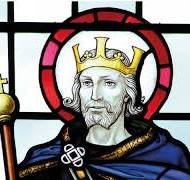
St Edmund was once at the very heart of England’s story. Before anyone in this country had heard of St George and his dragon, Edmund the Martyr was honoured as the first Patron Saint of England, especially from the 10th century through to the late Middle Ages. Over the last 39 years studying English history and saints’ cults, I’ve seen how his story combines hard fact, royal politics, and later legend, and how he gradually gave way to St George as England’s national figurehead.
In this article, I’ll walk you through who St Edmund was, his life and martyrdom, how his cult grew around Bury St Edmunds, why he became the first Patron Saint of England, and how – step by step – St George replaced him by the 15th century. Along the way I’ll point out where the evidence is firm and where we are dealing with medieval storytelling.
Who was St Edmund, the first Patron Saint of England?
The target question – “Who was St Edmund the first Patron Saint of England?” – has a surprisingly clear core answer backed by early sources. Edmund, often called Edmund the Martyr, was king of East Anglia in the 9th century, ruling from about 855 until his death on 20 November 869. He was probably born in 841 and is said to have been crowned or consecrated at Bures on Christmas Day, either 855 or 856.
As king, Edmund faced the “Great Heathen Army”, a large Viking force that invaded England in the 860s and attacked several Anglo‑Saxon kingdoms. The Anglo‑Saxon Chronicle records the army’s movements in East Anglia and neighbouring realms, and later hagiographers identify Edmund as one of the Christian kings who stood against them. In broad terms, the facts accepted by historians are:
- He ruled East Anglia as a Christian king.
- Viking forces overran the kingdom in 869.
- He died that year, probably in Suffolk, resisting their demands.
Already in the 10th century, Edmund’s death was remembered not just as a military defeat but as a martyrdom: he was honoured as a king who preferred death to betraying his faith or his people. That idea – a native English king dying for Christ against pagan invaders – is what eventually made him the first Patron Saint of England.
Edmund’s life and martyrdom: what the sources actually say
The earliest detailed life of St Edmund that we have is by Abbo of Fleury, written in the late 10th century, about a century after Edmund’s death. Abbo’s account is based, he says, on the testimony of St Dunstan (archbishop of Canterbury), who had heard the story from an older monk. It is devotional writing rather than a modern biography, but several consistent points emerge across sources.
Edmund’s kingship
- Edmund is described as a devout Christian ruler, raised in the faith and governing East Anglia with justice and piety.
- He appears in royal lists and charters as king from around the mid‑850s until 869.
- Later tradition emphasises his fairness and generosity, though specific acts are thin in the record and mainly preserved in hagiography.
From a historian’s perspective, we treat these character sketches with caution; they tell us more about the ideals of kingship than verifiable events. But it is fact that he was recognised as the legitimate king of East Anglia and that later generations remembered him as a model Christian ruler.
The Viking invasion and Edmund’s death
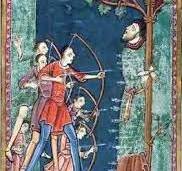
The Great Heathen Army entered East Anglia in the later 860s, after campaigns in Northumbria and Mercia. Contemporary or near‑contemporary sources record that East Anglia was “ravaged” and that Edmund was killed in that context. Abbo of Fleury’s account adds the famous details:
- Edmund is captured by Viking leaders (commonly associated with Ingwar/Ivar and Ubba).
- He is ordered to renounce his Christian faith and become a “puppet king”, sharing power under pagan control.
- Edmund refuses, declaring that he will not reject Christ or betray his people.
- As punishment, he is tied to a tree, shot with arrows until he is covered in them “like a hedgehog”, and finally beheaded.
The exact details – the tree, the hedgehog image, which Vikings were present – come from Abbo and later writers, not from the Anglo‑Saxon Chronicle. However, the core facts are well supported: Edmund died at Viking hands in 869 and his death was interpreted as martyrdom because of his refusal to submit or abandon Christianity.
The wolf and the talking head
One of the most distinctive parts of Edmund’s story is the fate of his head. Abbo and later legends say that after the execution, Edmund’s followers could not find his head until they heard a wolf calling “Hic, hic, hic” (“Here, here, here”) to guide them. The wolf is said to have protected the head from scavengers until the body was found and the two were reunited.
Historically, we treat the talking wolf as legend rather than fact, but the story is important because:
- It shows how strongly people believed Edmund’s body was miraculously preserved.
- It reinforced his status as a martyr under divine protection.
- It helped make him a popular saint – miracles are central to medieval cults.
In my experience, this is the detail that most sticks with people when they first hear about St Edmund: not just a king killed by Vikings, but a martyr whose head was guarded by a wolf in the Suffolk woods.
From royal martyr to national patron: the rise of St Edmund’s cult
After Edmund’s death, his body became the focus of a major shrine and pilgrimage centre. This is where the story of “Who was St Edmund the first Patron Saint of England?” moves from battlefield to monastery.
Translation to Beodricesworth / Bury St Edmunds
By the 10th century, Edmund’s remains (relics) had been translated to Beodricesworth in Suffolk, the place later known as Bury St Edmunds. A royal shrine grew up there, and by around 1020 King Cnut (Canute) founded a large stone abbey on the site, with Edmund’s shrine at its heart.
The abbey became one of the richest and most powerful in medieval England, supported by successive kings and nobles who saw Edmund as a national protector. Miracles were reported at his shrine, especially healings, and pilgrims travelled from across England (and beyond) to seek his intercession. One contemporary described the shrine as a destination on a par with Canterbury.
Patron saint of England in the Middle Ages
By the 11th and 12th centuries, St Edmund had moved beyond local hero status.
- He was honoured as the royal patron, especially for the English monarchy.
- He and Edward the Confessor were widely regarded as the patron saints of England before St George’s promotion, with Edmund often seen as the earlier and more “national” figure.
- His feast day, 20 November, was marked across the country.
A petition to Parliament in 2015 summarised the traditional understanding: that Edmund was Patron Saint of England from around the 10th century, sharing some honours with Edward the Confessor from 1066, until St George became the sole patron in the early 15th century. That fits well with both medieval sources and modern scholarship.
In other words, for several centuries when people in medieval England asked “Who is our patron saint?”, a factual answer would have been “St Edmund the Martyr”, sometimes alongside Edward the Confessor.
Why did St George replace St Edmund as patron saint of England?
The second part of the question is just as important: why did St Edmund give way to St George? Here we move from the 9th‑century martyr to 12th‑ to 15th‑century royal policy, crusading culture, and chivalry.
St George’s rise through the Crusades
St George was a soldier‑martyr venerated in the Eastern Mediterranean long before he had any special link to England. He was traditionally said to have been a Roman soldier, executed for his Christian faith around 303, probably in Palestine.
His connection with English kings starts in the Crusades:
- In 1191, during the Third Crusade, King Richard I (“the Lionheart”) visited the supposed tomb of St George at Lydda (modern Lod in Israel/Palestine).
- According to later accounts, Richard won a significant victory soon afterwards and attributed his success to St George’s intercession.
- Richard adopted St George as the patron of his army and promoted his cult on his return.
From the 13th century onwards, St George became strongly associated with Christian knighthood, military courage, and the idea of holy warfare – themes that resonated deeply with European monarchies of the time.
Edward III and the Order of the Garter
The crucial turning point comes under King Edward III in the 14th century. In 1348, Edward founded the Order of the Garter, England’s foremost order of chivalry, and placed it under the patronage of St George. At the same time, he adopted St George more explicitly as the patron saint of England.
Key facts:
- Edward III deliberately promoted St George as a symbol of royal and military identity, setting him at the centre of courtly chivalry.
- The red cross of St George became strongly associated with English forces in war.
- Throughout the late 14th century, royal and public devotion to St George intensified, especially in the context of the Hundred Years’ War with France.
By contrast, Edmund’s cult remained strong at Bury St Edmunds but lacked the same direct link to contemporary military campaigns and royal orders of knighthood. The shift was not because Edmund’s story had weakened, but because St George better matched the international, chivalric image the monarchy wanted to project.
Formal replacement in the 15th century
By around 1400, St George had effectively become the sole patron saint of England in official terms.
- Medieval commentators and later historians agree that Edmund’s national role faded in the 14th century as George’s rose.
- A BBC summary of the debate notes that Edmund and Edward the Confessor shared patronage earlier on, but that St George became England’s only patron saint around 1400.
- The Abbey of St Edmund states that Edmund was Patron Saint of England until about 1350, when he was replaced by St George. The precise year varies by source, but all point to the mid‑14th to early‑15th century as the period of transition.
Later, in the English Reformation, King Edward VI abolished banners of other saints, leaving the flag of St George as the main surviving national emblem. Shakespeare’s use of “God for Harry, England, and Saint George!” in Henry V further cemented St George in popular consciousness.
So, to answer the second part of “Who was St Edmund the first Patron Saint of England, and why did he give way to St George?” factually:
- Edmund’s cult as national patron grew from the 10th century, rooted in his status as a native king‑martyr.
- From the late 12th century, St George gained favour with English kings, especially Richard I and Edward III, as a martial, crusading saint.
- In the 14th and early 15th centuries, royal and military devotion to St George overtook Edmund’s older cult, and St George became recognised as England’s official patron saint.
Edmund, Edward the Confessor, and St George: overlapping patrons
One factual nuance that helps explain the transition is that medieval England could honour more than one “patron” at once.
- Edmund the Martyr was revered as the patron of the English kingdom and monarchy from roughly the 10th century.
- Edward the Confessor, king of England before 1066, also came to be regarded as a patron, especially for the monarchy and Westminster Abbey.
- St George gradually joined and then superseded them as the royal and national symbol.
A BBC discussion of campaigns to “restore” St Edmund points out that Edmund shared the title of patron saint of the monarchy with Edward the Confessor from 1066 onwards, while St George became England’s only official patron around 1400. The Abbey of St Edmund and other historical groups broadly agree with that timeline.
From a strictly factual angle, then:
- St Edmund was indeed an early and widely recognised Patron Saint of England.
- His cult coexisted with others, but he had a strong claim to be the first national patron.
- St George’s later dominance reflects changing royal and military tastes, not any correction of an earlier “mistake”.
St Edmund today: memory, campaigns, and historical interest
Although St George is now firmly established as the Patron Saint of England, St Edmund has never entirely vanished from the record.
Bury St Edmunds and ongoing devotion
Bury St Edmunds still carries his name and preserves the site of his medieval abbey and shrine. Although the abbey itself was largely destroyed after the Dissolution of the Monasteries, the ruins and surrounding town remain a focus of local identity and historical tourism.
Historic and local sources point out that:
- Edmund’s feast day is 20 November, sometimes marked as St Edmund’s Day.
- He is still recognised as patron of the Roman Catholic Diocese of East Anglia and of certain monasteries (such as Douai Abbey).
- There have been modern campaigns to re‑adopt St Edmund as England’s patron, or at least to give him a more prominent place alongside St George.
Modern campaigns and petitions
In recent years, several campaigns have tried to promote St Edmund as “England’s true patron saint”, arguing that he is a native English king who died defending his people, whereas St George has no direct historical link to England and serves as patron for many other countries.
- A 2006 campaign led to Parliamentary discussion but no change in official status.
- A 2015 e‑petition proposed restoring Edmund as Patron Saint; it summarised the historical case but did not alter the established position of St George.
- Local groups in Suffolk periodically mark St Edmund’s Day and raise awareness of his story.
These efforts show that the question “Who was St Edmund the first Patron Saint of England?” is not just academic. For some people, it has become part of a broader conversation about English identity, historical memory, and which figures best represent the nation.
Conclusion: answering “Who was St Edmund the first Patron Saint of England?” clearly
Putting the threads together, we can answer the central question factually.
- Who was St Edmund? He was Edmund the Martyr, king of East Anglia from about 855 until his death at Viking hands in 869, remembered as a Christian ruler who refused to renounce his faith or submit to pagan conquerors.
- Why is he called the first Patron Saint of England? From the 10th century onwards his shrine at Bury St Edmunds became a major national pilgrimage centre, and by the High Middle Ages Edmund – often alongside Edward the Confessor – was widely regarded as Patron Saint of England and of the English monarchy.
- Why did he give way to St George? From the late 12th century, English kings increasingly favoured St George, especially after Richard I’s crusading experiences and Edward III’s foundation of the Order of the Garter in 1348. By around 1400, St George had become the sole official Patron Saint of England, and Edmund’s national role faded, though his local cult continued.
FAQs
1. Who was St Edmund the first Patron Saint of England?
He was Edmund the Martyr, king of East Anglia from about 855 to 869, killed by Viking invaders after refusing to renounce his Christian faith, and later honoured as England’s first Patron Saint in the medieval period.
2. When and how did St Edmund die?
St Edmund died on 20 November 869, after the Great Heathen Army overran East Anglia; later sources say he was tied to a tree, shot with arrows, and beheaded for rejecting demands to abandon Christianity and submit to Viking rule.
3. Why is Bury St Edmunds important in his story?
In the 10th century his relics were moved to Beodricesworth (later Bury St Edmunds), where a powerful abbey and shrine grew up; it became a major pilgrimage centre and key reason he was seen as Patron Saint of England.
4. When did St George replace St Edmund as Patron Saint of England?
St George’s rise began with Richard I’s crusading devotion and was cemented when Edward III founded the Order of the Garter under St George’s patronage in 1348; by around 1400, George was recognised as England’s sole patron.
5. Is St Edmund still recognised as a saint today?
Yes. St Edmund remains venerated as a martyr; his feast day is 20 November, Bury St Edmunds still bears his name, and he is patron of the Roman Catholic Diocese of East Anglia and several religious communities, even though St George is the official Patron Saint of England.