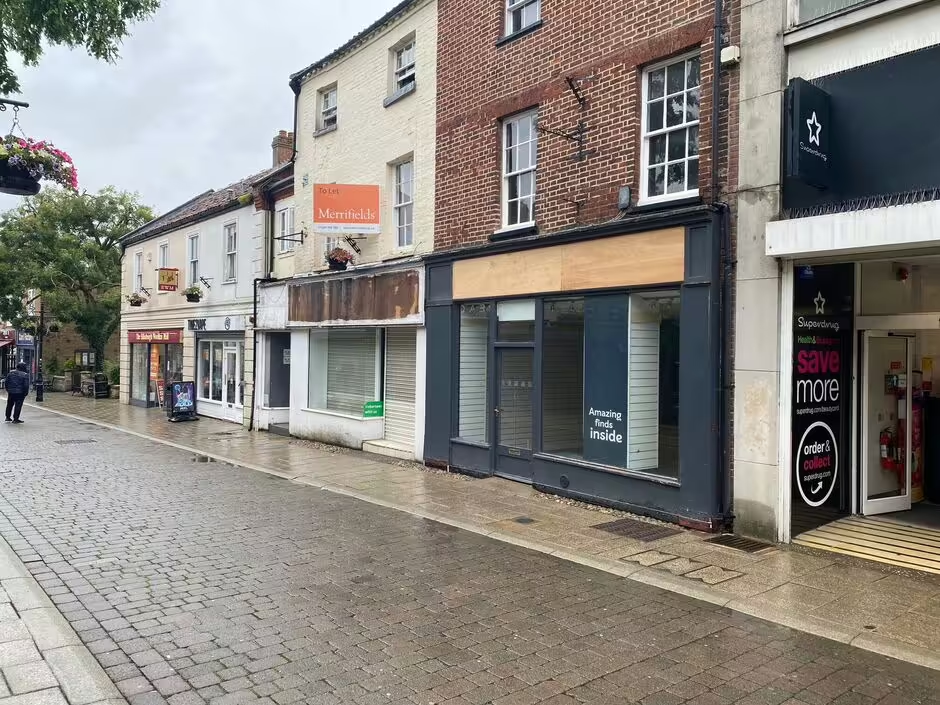
Twenty‑five years ago I flew back from Tenerife to visit family and walked through a town centre that felt like proper England, Thetford. Shops open, people chatting, market stalls busy, my mother‑in‑law proud of the place she’d moved to a few years earlier. Today that same high street is being written off as a rundown UK town centre that is “going down the pan”.
How does a lovely, lived‑in town end up with empty units, charity shops giving up, and locals telling reporters they’d rather drive to a retail park than walk down their own high street? I’ve been watching Westminster and the news for nearly 40 years. This is not an accident. It’s the direct result of choices made by people who barely know where these towns are, let alone care who lives there.
In this piece I’m going to spell out what happened to this town, why it happened, who is to blame, what a serious country would do about it, and what ordinary people can still do before the rot becomes permanent.
What happened to this town centre?
Let’s start with the obvious. You don’t need a think‑tank report to see what’s gone wrong. You walk down Thetford high street and instead of a row of butchers, bakers, newsagents and small clothes shops, you see shuttered units, “to let” signs, and the odd charity shop clinging on for dear life.
When even charity shops can’t make it work, you know the footfall has collapsed. The article talks about how stores have given up, how shoppers are heading out to retail parks, and how the centre itself feels dead. We’ve all seen this pattern: once a few anchor stores leave, the rest follow, and the town centre becomes somewhere you pass through, not somewhere you go on purpose.
I remember visiting from Tenerife and being struck by how normal and decent it all felt. There was nothing fancy about it – just a solid English town doing what English towns have done for generations. Now the same place gets framed as “rundown” and “going down the pan” and the political class acts surprised. Were they not paying attention for the last quarter of a century?
Why did it happen – the policy choices behind the decay
People like to pretend this is just “modern life”. Online shopping, Amazon, people driving more, blah blah. Convenient story, but it’s only half the truth. Town centres don’t die on their own. They’re killed by a mix of planning decisions, tax rules, and political cowardice.
Out‑of‑town retail parks didn’t drop out of the sky. Councils signed off those planning permissions. They welcomed big sheds on bypasses and ring roads because that’s where the big chains wanted to be. They set parking charges and restrictions in the town centre while making it easy to drive and park for free at the retail parks. Of course people follow convenience. But convenience was engineered that way.
Business rates and rents hit small town‑centre shops hard while big corporates negotiate deals and play the system. National governments of all stripes sat back and watched. Every time there was a review, a consultation, a “taskforce”, the answer was the same: do as little as possible and let “the market” decide.
I’ve watched these promises since the 1980s. Enterprise zones, regeneration funds, levelling up. Every few years a minister rolls into some battered town, gets their photo taken next to a mural, signs off a small grant, then disappears. The underlying policies – the ones that make it easier to build another retail park than support a struggling high street – stay exactly the same.
So yes, online shopping plays a role. But it’s lazy to pretend this is just about websites and changing habits. It’s about a political class that finds it easier to let England’s small towns fade than to confront big landlords, corporate chains, and their own rotten planning system.
Who is to blame – and who hides behind excuses
Let’s name some culprits.
First, local councils. They decide on planning applications. They control parking and local transport. They have huge influence over whether a town centre is accessible and attractive or hostile and inconvenient. Yet when things go wrong, they point up the chain and mutter about “austerity”.
Second, landlords and big property funds. They treat town‑centre units as chips in a portfolio. Keep rent expectations high, sit on empty buildings, wait for a better offer or write it off. They don’t live in these towns. They don’t care if the shop front sits boarded up for years. They care about yield and balance sheets.
Third, Westminster. This is the big one. For decades the main parties have nodded along with a model that drains life out of small towns while pretending to be “pro business”. The truth is they’re pro‑corporate convenience and anti local independence. They protected the interests of retail chains and left small shops to fend for themselves.
I remember watching ministers on TV talking about “supporting our high streets” while simultaneously refusing to touch business rates in any serious way. They’d launch glossy campaigns – “Shop Local”, “Love Your High Street” – while ignoring the fact that local people were being hammered by wages that didn’t keep up, bills through the roof, and parking policies that treated drivers as cash cows.
Every time a town centre like this one reaches crisis point, the political class pretends it’s a mystery. How did it happen? Why are people not using the high street? As if they weren’t the ones who spent decades writing the rules that pushed trade out of the centre and into big, boxy units on the edge of town.
So who is to blame? Councils that went along with it, landlords who treated communities as spreadsheets, and Westminster parties that still don’t see England as a nation of towns and villages worth protecting – just as places to squeeze for tax and votes.
What a proper country would do for rundown UK town centres
Let’s imagine for a moment we lived in a serious country that actually cared about towns like the one my mother‑in‑law moved to.
For a start, business rates would stop punishing small town‑centre shops while rewarding big box retailers and online giants. A serious government would tilt the system in favour of independent high‑street businesses. Lower, smarter local taxes for shops that create jobs and footfall in the centre. Tougher rules on empty properties and speculative ownership.
Parking and transport would be geared to make the town centre the easiest choice, not the hardest. Short‑stay free parking for locals. Sensible bus routes and rail connections that drop people near the centre, not miles away. Instead of squeezing visitors, councils would recognise that every pound spent on the high street helps keep the place alive.
Planning policy would treat high streets as civic assets. That means stricter controls on out‑of‑town developments that cannibalise the centre. It means supporting mixed use – homes above shops, small offices, public services scattered through the centre – so people have reasons to be there all day, not just at 11am on a Saturday.
And deeper than all that, a serious country would speak honestly about the cultural side. Town centres are not just shopping “destinations” in some marketing brochure. They’re part of English life: where people bump into neighbours, where local gossip and news travels, where you see the same faces across years. When we let that go, we’re not just losing shops. We’re losing memory, continuity, and a sense of belonging.
Instead we get ministers waffling about “modernising the retail environment” while treating dying high streets as acceptable collateral damage. They talk like consultants while real places fall apart.
What ordinary people can actually do
So what do we do, standing in a rundown UK town centre that feels nothing like the place our family moved to decades ago?
First, use what’s left. It sounds small, but it matters. If there’s still a butcher, a newsagent, a small café, use them. The difference between a surviving shop and a shuttered one can be a few dozen loyal customers. If we spend everything online or in retail parks, the high street simply won’t survive.
Second, demand transparency and fight back locally. Councils don’t like being challenged, but they work for you, not the other way round. Ask for clear numbers: what are the parking revenues, how much is spent on the town centre, what decisions have been made about new retail parks and out‑of‑town developments. Put it in public, share it on Facebook, local forums, wherever people in the area actually read.
Third, organise. One angry voice gets ignored. Fifty voices in a room with councillors is harder to brush off. Residents’ groups, traders’ associations, informal local campaigns – whatever suits your town. The key is to point at concrete decisions: parking policies, business‑rate relief schemes, planning approvals. Don’t let them hide behind vague talk of “market trends” and “changing consumer demands”.
Fourth, stop rewarding the same political parties that watched this happen and shrugged. If national politicians only ever pay a price for wrecking towns like this in terms of bad headlines, nothing changes. They need to feel it at the ballot box. That means being willing to stop voting out of habit and start voting with a bit of anger and memory.
Finally, talk about the town with some pride, even now. One of the most demoralising things is when people start to believe their town is worthless. It isn’t. It’s being badly run and badly served. That can change. I remember how good it felt 25 years ago to walk through that centre as a visitor and feel like I was in a living, breathing place. That feeling can come back – but not while we all pretend politics has nothing to do with it.
Conclusion: stand up for your town or watch it die
Here’s the blunt truth. A rundown UK town centre isn’t just a sad story in a newspaper. It’s a sign that the people in charge have stopped caring whether England’s towns survive as real communities or fade into retail parks and distribution hubs.
For nearly 40 years I’ve watched Westminster sell us slogans while quietly signing off the decisions that drain life out of places like the one my mother‑in‑law moved to with hope. I’ve watched ministers talk about “supporting local communities” while their policies do the exact opposite.
If we treat this as normal, we’ll keep losing towns, one by one, until the only “centre” left is a retail shed on the bypass and a few pubs holding on out of sheer stubbornness. If we stand up – use what’s left, demand answers, organise, and vote with our eyes open – we at least give our towns a fighting chance.
The choice is simple: either we defend the places that make England feel like home, or we watch them go down the pan while the same people in Westminster collect their salaries and tell us it’s all just “modern life”. Which side are you on?