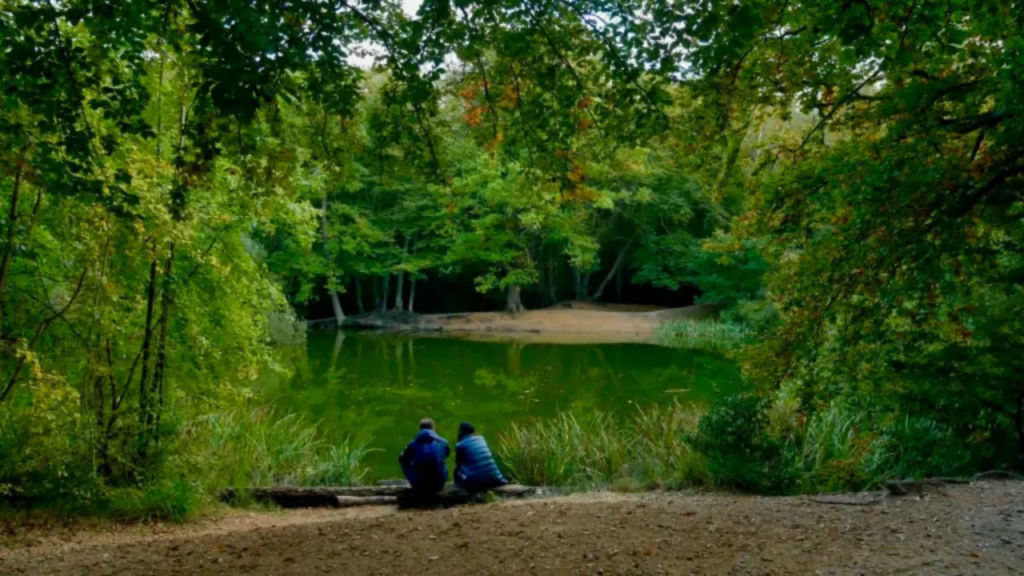
Most people see an old village pond and think it is there to look pretty.
A few ducks.
Some reeds.
Maybe a bench and a willow tree.
The sort of thing estate agents put in photographs when they are trying to sell “charming village life”.
But that is not why these ponds were there.
They were there because people needed them.
They watered animals.
They helped put out fires.
They were used for carts, tools and everyday village work.
They sat beside greens where livestock grazed.
They were part of how a village looked after itself.
Not romantic.
Not complicated.
Just practical England getting on with it.
I started noticing them near Epping Forest
I live near Epping Forest, and if you walk around it enough, you start noticing ponds.
Some are obvious.
Some are tucked away where you could walk past them ten times and barely register them.
Some are near paths that people have probably been using for generations. Some are hidden behind trees and brambles. Some look ancient, even if they are not.
I have walked past a few of them more times than I could count.
You see the water, the reeds, the birds, maybe a dog walker. Then you carry on.
But once you stop and think about it, you start asking yourself why it is there.
Who dug it?
What was it used for?
What was this place like before everyone had a tap, a hosepipe, a car and a Tesco five minutes away?
That is what I like about living near Epping Forest. England’s history is still there if you bother to look.
It is not all in museums.
It is in the tracks through the trees, the old place names, the village greens, the hedgerows and these ponds that most people barely notice.
Blackweir Pond, better known locally as the Lost Pond, is one example. It looks like it belongs completely to the Forest now, but it began life as a gravel extraction pit. Nature took over, and it became one of the quietest and most picturesque places in the Forest.
That tells its own story.
Not every pond is medieval.
Not every pond was for livestock.
But nearly every old pond has a reason for being there.
And once it is gone, that reason is usually forgotten too.
A pond was not a water feature
We have this modern habit of calling everything a “feature”.
A pond becomes a water feature.
A village green becomes public realm.
A field becomes a development opportunity.
A country lane becomes an active travel route.
It all sounds very clever, but half the time it just means somebody is trying to make something ordinary sound like it belongs in a planning document.
An old village pond was not a water feature.
It was useful.
In the days before mains water, village ponds were vital. Livestock needed drinking water. Cattle, horses, sheep and geese were part of everyday life in rural England. A pond near the village green or common was not an accident. It was there because animals were grazed there and animals need water.
That is not difficult to understand.
A village was not built around coffee shops and delivery drivers. It was built around farming, animals, work, family and getting through the year.
The pond was part of that.
It might not look much now, but once it could have been one of the most important places in the village.
The village green and the pond
People often look at a village green now and see a nice patch of grass.
Maybe there is a cricket match once in a while.
Maybe children play there.
Maybe it gets used for a fete or a Christmas tree.
All good things.
But village greens were not created just to give people somewhere pleasant to sit with an ice cream.
They were working parts of a village.
Many had common rights attached to them. That could include grazing livestock. Common land itself was land where people had recognised rights to use certain resources, including grazing.
So the green and the pond went together.
Animals grazed.
Animals drank.
People met.
Carts passed through.
News travelled.
Arguments happened.
Deals were done.
Life went on.
This is what gets lost when we turn every bit of old England into a postcard.
Village life was not all roses around the door and a vicar cycling past in the sunshine.
It was muddy. It was hard work. It probably smelled a lot worse than it does now.
But it was local.
People knew the place they lived in.
They knew who was responsible for what.
They knew where the water was, where the animals were meant to be and what happened when somebody’s animal got loose.
That is where the pinfold came in.
The pond, the green and the pinfold were all part of the same world. A world where villages had to sort things out for themselves.
Water, animals and fire
A pond had more than one use.
Obviously, animals drank from it.
But it could also be used when there was a fire.
Think about old cottages, barns and outbuildings. Timber. Thatch. Hay. Straw. Coal fires. No fire engines coming from ten minutes away with modern equipment.
A serious fire could wipe out a family’s home, a farm building or half a row of cottages.
If there was a pond nearby, there was water.
Buckets could be filled.
A bucket chain could be formed.
People could at least try to stop the flames spreading.
Village ponds were also used for washing, soaking cartwheels and other day-to-day work. Cart wheels could be soaked to stop the wood shrinking away from the metal rim. People used ponds for washing clothes, and animals were watered there before heading on to market or further grazing.
This was working infrastructure.
It was not perfect. It was not clean by today’s standards. Nobody is arguing that we should swap running water for a murky pond at the end of the road.
But it worked for the people who needed it.
And the point is this: villages had what they needed because somebody, somewhere, had made sure they did.
England used to solve local problems locally
This is what keeps coming back to me when I look at old village life.
England used to be much better at local responsibility.
If an animal was loose, there was a pinfold.
If animals needed water, there was a pond.
If the village needed shared grazing, there was a green or common.
If something needed repairing, there was a smithy.
If the community needed to make a decision, people who lived there got involved.
It was not some golden age. I am not pretending it was.
Old England had poverty, disease, hard work and plenty of unfairness. Anyone claiming otherwise is selling a fantasy.
But we have gone too far the other way.
Now everything is someone else’s job.
The council.
The contractor.
The Government.
The consultant.
The “stakeholders”.
The people who actually live in a place are often the last ones asked what should happen to it.
Then they are told the decision is already made.
That is not progress.
That is just taking power away from ordinary people and calling it efficiency.
What happened to the village pond?
A lot of them disappeared because people no longer needed them in the same way.
Mains water came in.
Modern drainage arrived.
Farming changed.
Cars replaced horses.
Fire services became organised and properly equipped.
Fair enough. Life changes.
But plenty of ponds were also neglected, polluted, drained, filled in or simply built over.
They became inconvenient.
A bit of land someone wanted.
A safety risk.
A maintenance problem.
A place that looked untidy.
That is how history disappears.
Not always with a bulldozer and a ribbon-cutting ceremony.
Sometimes it is just neglect.
Sometimes somebody says, “It is only a pond.”
But it is never only a pond.
It is part of the reason a village grew where it did.
It tells you how people lived.
It tells you what mattered to them.
It tells you how they managed before modern life made us forget where water comes from and what a community needs to survive.
England once had ponds at nearly every village and farm. As modern water supplies and farming methods changed, many were lost. That is not just bad for wildlife. It means another small piece of England’s local history goes with them.
The trouble with “progress”
I am not against change.
Nobody who has lived through the last few decades can seriously be against all change.
We have better medicine. Better sanitation. Better housing in many ways. We do not want to go back to people dying from things we can now treat. I nearly died from tuberculosis in the 1990s, but I survived because of modern medicine.
So no, I am not pretending everything was better in the past. It was not. But not every change is progress either.
Sometimes “progress” means knocking down something useful and replacing it with something bland.
Sometimes it means taking a village that has grown over hundreds of years and treating it like an empty space on a map.
Sometimes it means building houses without the roads, doctors, school places, drainage or community facilities to go with them.
Then the people who object are called NIMBYs.
They are told they do not care about young people needing homes.
They are told they do not understand the bigger picture.
The bigger picture is usually that someone else makes money, while the people who live there get the traffic, the pressure on services and the loss of another bit of the place they love.
That is why these small bits of England matter.
A pond.
A green.
A hedge.
A local footpath.
An old building.
A village pub.
They are not just things standing in the way of somebody’s plan.
They are what makes a place feel like home.
What Epping Forest reminds me
Epping Forest is not just a big bit of green near London.
It is a reminder that England has survived because people fought to keep parts of it.
The Forest has ancient trees, old grazing traditions, heaths, grassland and water. It is a working historical landscape, not just somewhere to walk the dog on a Sunday.
That matters to me.
Because once a place is gone, it is gone.
You cannot rebuild an ancient wood in five minutes.
You cannot replace an old footpath with a pavement beside a new estate and pretend it is the same thing.
You cannot fill in a pond, build over a field, cut down a hedge, lose a local pub and then tell people they should be grateful for “regeneration”.
Maybe some people are happy with that.
I am not.
I want England to move forward, but I do not want it stripped of everything that makes it England on the way.
Start noticing what is around you
That is really the point of this.
Next time you walk past an old pond, stop for a minute.
Do not just see a bit of water with ducks on it.
Ask why it is there.
Ask how long it has been there.
Ask what the village looked like when it was needed every day.
Ask what else used to be around it.
Was there a green nearby?
A smithy?
A pinfold?
Old cottages?
A track leading out towards the fields?
You will probably find that the pond is part of a much bigger story.
And it is a story worth knowing.
England is full of these things.
Bits of history we pass every day without a second thought.
The trouble is, by the time people notice they matter, someone has often already decided they are in the way.
Final thought
The old English village pond was not a luxury.
It was not a decorative feature.
It was part of village life.
It watered animals. It helped fight fires. It gave people a shared resource. It sat alongside the green, the pinfold, the church, the smithy and the paths people used every day.
It was ordinary.
And that is exactly why it matters.
England was not built only by kings, battles, castles and country houses.
It was built by ordinary people in ordinary places, doing what had to be done to keep their village going.
The pond was one small part of that.
We should not forget it.
And we should not be so quick to lose the things that remind us where we came from.