There’s a story about England and slavery that almost nobody tells honestly.
You get two versions shoved at you. The activist version: England was a brutal slave empire and every white person alive today carries the guilt for it. The establishment version: Britain heroically abolished slavery and we should all feel proud.
Both versions are wrong. Both are dishonest. And after over forty years watching Westminster operate, I’ve learned one thing. When both sides of the official story are convenient, someone is getting away with something.
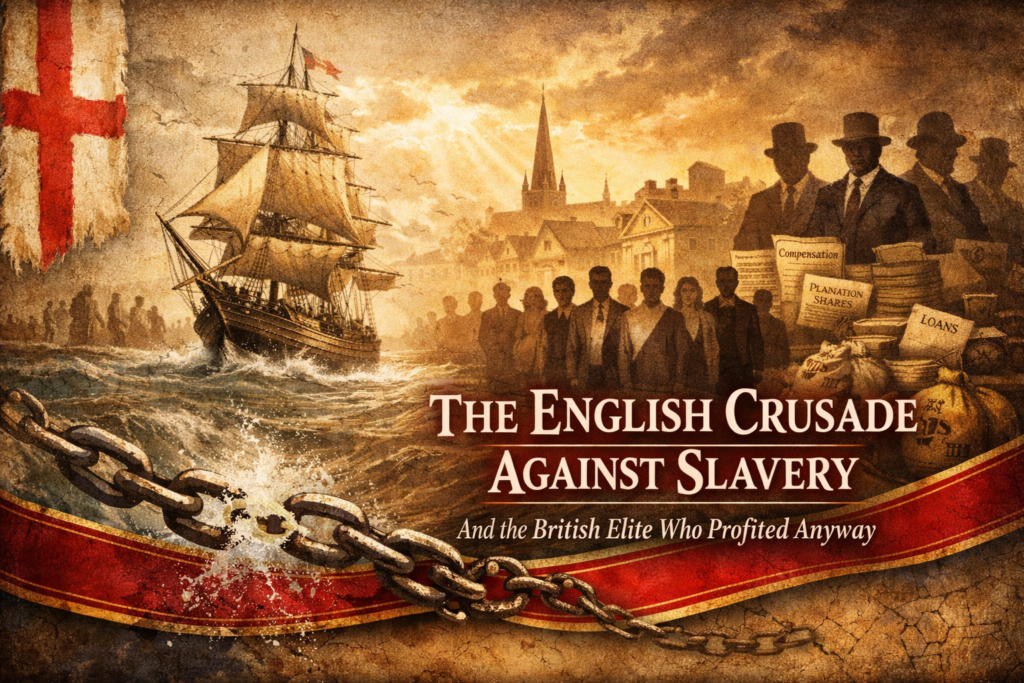
Here’s the truth. Ordinary English men and women fought for decades to end slavery on moral grounds. They won. And then the same establishment that ran the slave trade walked away with a cheque.
That’s what this piece is about. And I make no apology for saying it plainly.
What Actually Happened: The English Abolition of Slavery
The English abolition of slavery didn’t come from the top. It came from the bottom.
The Society for Effecting the Abolition of the Slave Trade was founded in 1787. Most of its twelve founding members were Quakers. Not lords. Not MPs with Caribbean estates. Ordinary people who looked at what was being done in England’s name and said: this is wrong, and we’re going to stop it.
William Wilberforce took it into Parliament. He introduced abolition bills repeatedly and was blocked repeatedly — not by public opinion, but by the vested interests of plantation owners sitting in the Lords and funding political campaigns. Sound familiar? Different century, same game.
The Slave Trade Act finally passed in 1807 after twenty years of effort. But it only banned the trade, not ownership. Enslaved people were still enslaved. The full Slavery Abolition Act came in 1833, freeing over 800,000 people across the empire.
That is a genuine moral achievement. A real one. Don’t let anyone take that from you or bury it under a guilt trip.
But here’s where the story gets darker.
The Cheque That Tells You Everything
To get the Slavery Abolition Act through Parliament, a compromise was made. Slave owners would be compensated for their “lost property.”
The figure agreed was £20 million. That was roughly 40% of the entire government’s annual budget at the time. In today’s money, estimates run to around £17 billion.
The people freed from slavery got nothing. Not a penny. Not an acre of land. Nothing.
The money went to the men who had owned them.
To fund the payout, the government needed to borrow. Nathan Mayer Rothschild and his brother-in-law Moses Montefiore were commissioned to arrange the loan. Rothschild put together a banking consortium that provided the full £20 million to the British government. It was one of the largest financial transactions in history at that point.
That debt was loaded onto the public finances. It was turned into long-term government bonds. And English taxpayers — including people who had marched, petitioned and campaigned against slavery — paid it off over generations. HM Treasury confirmed in 2015 that the final payment on that debt had only just been made.
Read that again. English taxpayers were still paying off a debt to slave owners in 2015.
I grew up in East Ham, E6, east London. Working class through and through. My grandparents’ generation were working people. They never owned a slave. They never owned much of anything. But their taxes went into those bonds decade after decade while the families who pocketed the compensation were sending their sons to Eton and becoming MPs. I live out in Epping Forest now, and my closest family mainly live further into Essex. Different postcodes, same story. Ordinary English families who carried the cost of decisions made by people who wouldn’t have given us the time of day.
A banking consortium arranged the loan. The establishment collected the compensation. And ordinary English people paid the bill for over 180 years.
The establishment didn’t just profit from slavery. It profited from ending it.
The English vs The British Establishment: The Distinction Nobody Wants to Make
This is the bit that blows the whole modern racism argument apart — which is exactly why nobody in the mainstream will touch it.
When activists say “Britain” owned slaves and profited from empire, they are telling a half truth that works as a lie.
“Britain” didn’t own slaves. Specific people did. Plantation owners. Merchant families. Investors. Lords with Caribbean estates. The same people who sat in Parliament blocking abolition for twenty years. The same people who lobbied for compensation when they lost.
Ordinary English people didn’t own slaves. Many of them actively fought to end it. They paid taxes into an empire they had no democratic say in running. Westminster wasn’t a democracy. It was a parliament of property owners. If you didn’t own land, your opinion didn’t count.
I’ve been watching this pattern my whole adult life. The people at the top make the decisions. The people at the bottom carry the consequences. And then someone comes along and tells the people at the bottom that they are the guilty ones.
So when someone tells me I need to carry personal guilt for slavery, I ask one simple question. Which English person? The Quaker in Manchester who signed the petition in 1787? The factory worker whose taxes paid off the slave owner’s compensation in 1960? Or the Duke whose family pocketed the cheque and still owns half of the county?
The English abolition of slavery was won by English people against the resistance of the British establishment. That is not a footnote. That is the whole story.
Who Is Actually to Blame — and Who Gets Away With It
Here’s what I’ve noticed over forty years of watching Westminster.
The establishment is brilliant at spreading guilt downward and keeping wealth upward. It has been doing it for centuries and it hasn’t stopped.
When slavery ended, the people at the top kept the money. When the empire declined, ordinary English people were told to feel ashamed of it. When mass immigration followed decolonisation — decisions made by governments, not voters — ordinary English communities were told they were racist for even noticing.
The families who profited from slavery didn’t get lectures about guilt. They got country estates, seats in the Lords, and their names on university buildings. Some of those families still have all three. Go and look up the UCL Legacies of British Slavery database if you don’t believe me. The names are there. The amounts are there. It’s all public record.
Meanwhile the activists and academics focus their fire on “whiteness” as some kind of collective. On ordinary English people who never owned a slave, never ran a plantation, never wrote the laws. People whose ancestors were in the docks, down coal mines and in cotton mills when the empire was making its money.
That is a deliberate misdirection. Keep people arguing about race and collective guilt. Keep them pointing fingers at each other. And nobody looks too hard at the specific institutions and families who still hold wealth built on enslaved labour.
The Church of England. The Bank of England. Lloyd’s of London. Various Oxford and Cambridge colleges. These are institutions with names, addresses, accounts, and assets. If there is any reckoning to be had, it starts there — not with every English person who ever drew breath.
What a Serious Country Would Do
A serious country would tell this story honestly in its schools.
It would teach children that the English abolition of slavery was a genuine moral achievement, driven by ordinary people against an establishment that fought it every step of the way. Not a source of shame. A source of hard-won pride.
It would put the UCL Legacies of British Slavery database on the curriculum. Name the institutions. Name the families. Name the amounts. Let people see exactly where the money went and who still benefits.
It would ask hard questions of those institutions today. Do the colleges, banks and insurers that were built on slavery still hold assets traceable to that wealth? If so, what is their obligation? That is a legitimate conversation. Collective racial guilt spread across an entire population is not.
It would stop using history as a weapon to silence ordinary English people who ask reasonable questions about their own country. Questions about immigration. About belonging. About who gets to decide what England looks like. Those are not racist questions. They are democratic ones.
A serious country would have that conversation. Our British Establishment refuses to let us:
Mass Immigration and the Guilt Trap
Here’s the question nobody in the media or politics will answer honestly.
England never voted for mass immigration. Not in 1948. Not in the 1960s. Not in the 1990s. Not now. Every significant wave was a decision made by governments, by establishment figures, by people who did not live with the consequences and whose children went to schools that weren’t affected.
I live around Epping Forest now. I’ve watched this place change over the last 30 years. I’m not saying that change is all bad. But I am saying nobody asked us. Nobody held a vote. Nobody sat down with ordinary English communities and said: here is what we are planning, what do you think?
And then when people like me raise it, we get told we are racist. That our discomfort is white supremacy. That our culture and history are nothing but a catalogue of crime.
If England is so irredeemably horrible, why does every man and his dog want to live here? People cross continents to get here. They cross the Channel in dangerous conditions to reach this country. You don’t do that to reach somewhere you think is evil. You do it because England has rule of law, a welfare state, relative safety, and more opportunity than wherever you left.
That tells you the truth about England far more honestly than any academic paper written by someone who has never lived outside a university campus.
What Ordinary English People Can Actually Do
Stop accepting guilt that was never yours to carry.
Learn the real history of the English abolition of slavery. It is your history too. Not just the empire’s crimes but the English people’s resistance to those crimes. Know it, use it, and don’t let anyone bury it under a one-sided story.
When someone tells you Britain was a slave empire and you should feel shame, ask them to be precise. Which Britain? The Quaker petitioner or the plantation owner? The taxpayer who paid the debt for 180 years or the family that received the cheque? Demand precision. Refuse vagueness. Vagueness is how they get away with it.
Push accountability toward the right targets. Institutions. Families. Corporations. The ones with names and assets and paper trails. Not every English person who ever existed.
Engage without apology. You can acknowledge history is complicated, that real harm was done, and still refuse to accept personal guilt for decisions made by a ruling class your ancestors had no vote over. Both things are true at the same time.
And say what you actually think. One reason this debate always goes the same way is that ordinary English people have been trained to stay quiet. The moment you speak you get called racist. So most people say nothing, and the loudest voices in the room set the terms.
Stop letting them set the terms.
Conclusion: Stop Letting Them Rewrite Your Story
The English abolition of slavery is one of the more remarkable things that ever happened in this country. Ordinary people — Quakers, evangelicals, working men and women with no political power — forced the most powerful empire on earth to change its laws on moral grounds.
Then the establishment, as it always does, found a way to profit from it.
And now, nearly two centuries later, the descendants of those ordinary English people are being told they are the villains. That asking questions is racism. That pride in their country is white supremacy.
I’ve watched Westminster operate for nearly forty years. I’ve seen governments lie about immigration numbers, expenses, foreign wars, and economic data. I’ve watched the same establishment families rotate through politics, banking, media and law. And I’ve watched ordinary English people carry the cost of decisions they never made and never voted for.
This is the same trick. Spread the guilt wide. Keep the money narrow. And make sure nobody looks too closely at who actually holds it.
Know your history. All of it. The shame and the courage together. Because the people who fought to end slavery deserve far better than to have their achievement buried under a guilt trip designed by the very class that made a fortune from their victory.
Don’t let them rewrite your story.
Angry? You should be. Join our They Work For Us campaign group and help us hold the establishment to account. Add your details below. It costs nothing but your silence to stay out. And silence is what they’re counting on.
FAQs
Q: Did England really lead the world in abolishing slavery?
A: Yes. The Slave Trade Act 1807 and the Slavery Abolition Act 1833 made England one of the earliest nations to formally outlaw both the trade and the ownership of enslaved people across its empire.
Q: Who received the £20 million compensation when slavery was abolished in 1833?
A: Slave owners received it, not the people who had been enslaved. It compensated owners for their lost property and was financed by government borrowing repaid by ordinary taxpayers over generations.
Q: How was the £20 million slave owner compensation loan arranged?
A: Nathan Mayer Rothschild and Moses Montefiore were commissioned to arrange the loan. Rothschild put together a banking consortium that provided the full £20 million to the British government in what was one of the largest financial transactions of the era.
Q: When did England finish paying off the slave owner compensation debt?
A: HM Treasury confirmed in 2015 that the debt used to fund the £20 million slave owner compensation had only just been fully repaid, meaning English taxpayers were effectively still servicing that debt into the 21st century.
Q: Were ordinary English people responsible for the slave trade?
A: The slave trade was run by a specific class of merchants, plantation owners and establishment figures. Most ordinary English people had no vote, no say and no share in the profits. Many actively campaigned against slavery for decades before abolition was achieved.
That many actively campaigned against slavery is one of the most remarkable achievements in this country’s history. I only wish that as much energy had been put into the fight against the very poorest in society, the men and women who toiled in the “dark satanic mills”, and the children who worked in the mines, and up the chimneys, as well as the mills.