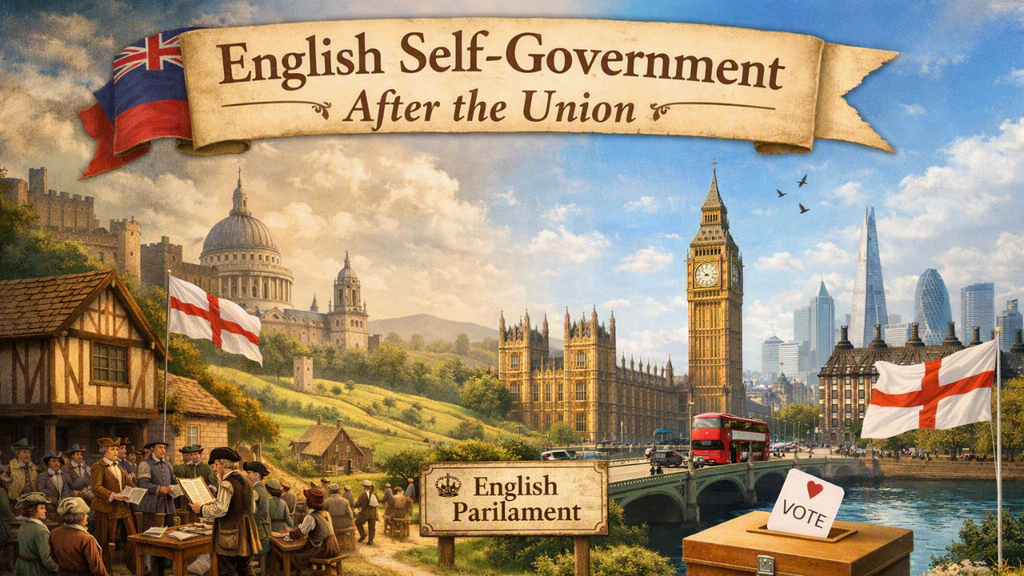
The leaders of Scotland, Wales and Northern Ireland have met and declared that constitutional change is coming.
They say their nations have the right to self-determination. They say Westminster should prepare, plan and facilitate change. They say the old political order is running out of road.
Good. At least somebody is finally speaking plainly.
For too long, the political class has treated the United Kingdom as if it were an eternal fact of nature. It is not. It is a political arrangement. It was made by Acts of Parliament, treaties, bargains, pressure, patronage and power. What was made can be changed.
The meeting in Cardiff does not repeal the Acts of Union. It does not make Scotland independent. It does not deliver Welsh independence. It does not unite Ireland. It has no immediate legal force.
But it is a marker in the ground.
John Swinney, Rhun ap Iorwerth and Michelle O’Neill have put Westminster on notice. Their parties are not merely asking for another committee, another funding formula or another set of powers to be handed down from London. They are saying that Scotland, Wales and Northern Ireland must be free to decide their own futures.
That raises a question which is just as important, and which the British political class has spent generations avoiding:
What about England?
If the Union is no longer beyond question, England must not be treated as the silent remainder. If Scotland may speak as Scotland, Wales as Wales and Northern Ireland according to the principle of consent, then England must be free to speak as England.
That is the case for English self-government.
Not against Scotland.
Not against Wales.
Not against Ireland.
For England.
What actually happened in Cardiff?
Let us deal with the facts first, because Westminster politicians and television pundits thrive on muddle.
The leaders involved signed a memorandum of understanding on self-determination. The declaration says their nations have the right to determine their own futures by democratic means. It calls on the UK Government to “prepare, plan and facilitate” constitutional change in the three jurisdictions. It also points towards closer cooperation on economic policy, energy and relations with the European Union.
The political aims are not identical.
The SNP wants Scottish independence.
Plaid Cymru wants Welsh independence.
Sinn Fein wants Irish reunification, under the constitutional arrangements surrounding Northern Ireland.
Different countries. Different histories. Different routes. Different arguments.
That matters. It would be wrong to pretend that one joint press conference has produced a single Celtic super-state or a timetable for the UK’s disappearance. It has not.
The pact is symbolic. Even constitutional specialists have said it has no legal effect by itself. A speech, declaration or memorandum cannot unmake an Act of Union. Scotland cannot simply vote itself out through Holyrood without Westminster’s consent under the present legal framework; the Supreme Court made that clear in 2022.
But symbols can matter when they show a real change in political confidence.
For years, Westminster has relied on a familiar trick. It pretends that constitutional questions are either settled forever or so complicated that ordinary people should leave them to barristers, civil servants and the same politicians who have botched almost everything else.
Now the leaders of three nations are saying the opposite. They are saying the question is live.
They are saying the old order can be challenged.
And once that is admitted, England must ask what it wants.
This is not a quarrel with Scotland, Wales or Ireland
There is a bad habit in British politics. The moment England is mentioned as a nation, somebody tries to turn it into a row about hostility, resentment or race.
It is lazy. It is dishonest. And it is designed to close down the argument before it begins.
England does not need to hate anyone in order to govern itself.
I do not begrudge Scotland its right to choose Scotland. I do not begrudge Wales its right to choose Wales. I do not begrudge the people of Northern Ireland their right to decide their constitutional future through democratic consent.
Why would I?
A country secure in itself does not need to keep its neighbours trapped in an arrangement they no longer want. Nor should it accept being treated as nothing more than the cash machine, the voting bloc or the unnamed middle bit of a British state that refuses to say England’s name.
The best future for these islands may be one of friendly nations dealing with one another honestly.
That is better than the present arrangement, where everyone talks about partnership while Westminster keeps the final word, controls the constitutional machinery and expects England to have no separate view at all.
The people of Scotland are Scots. The people of Wales are Welsh. The people of Northern Ireland have their own complex identities, loyalties and constitutional rights.
And the people of England are English.
That should not be a controversial sentence. Yet in polite Westminster circles, it often is.
The political class has spent decades talking about Britishness because Britishness is useful to the state. It smooths over questions they do not want asked. It allows them to speak as if England, Scotland and Wales are merely counties in one large administrative district. It lets them wave a Union flag and avoid explaining who exactly is represented by whom.
But nations are not erased by the convenience of a government press office.
Friendship does not require disappearance.
Mutual respect does not require political absorption.
England existed before Britain
This is where basic history matters.
England was not created in 1707. England was not renamed “Britain” in 1707. England did not become a country because Westminster later called itself British.
England existed long before the Union.
Before 1707, there was the Kingdom of England. There was the Parliament of England. There was English common law. There was an English political tradition, an English national identity and a country called England.
The Acts of Union joined the Kingdoms of England and Scotland into a new kingdom called Great Britain. They created a new Parliament of Great Britain. England did not vanish from the map, but it ceased to exist as a separate state with its own Parliament.
That is not a minor detail. It is the whole point.
Westminster still sits in England. Most MPs have English seats. English taxpayers pay a huge share of the bills. English law remains central to the system.
But Westminster is not the Parliament of England.
It is the Parliament of the United Kingdom.
It legislates on UK-wide matters. It carries British state obligations. It runs a British civil service, British armed forces, British diplomacy and British public institutions. It has been built and altered over three centuries to govern a union state.
That is why the lazy answer—“England already has Westminster”—does not stand up.
If Scotland’s Parliament is called Scotland’s Parliament, and the Welsh legislature is called the Senedd, why is England expected to regard a UK Parliament as its own national Parliament while it serves several nations and a union-state system?
England has been asked to confuse being dominant in numbers with being represented as a nation.
They are not the same thing.
A man may be the largest shareholder in a company and still have no control over how the company is run. England may have the largest population in the UK and still lack a distinct constitutional voice.
That is the English question.
And it will not disappear just because commentators keep saying “Britain” every second sentence.
Westminster buried the English question
Who is to blame?
The easy answer is “the establishment,” and there is truth in it. But let us be more specific.
Labour has treated England as a problem to be managed. It built devolution for Scotland, Wales and Northern Ireland, then acted surprised that England began asking where its own national institution was.
The Conservatives have talked about the Union, waved flags, sung hymns to British tradition and then done almost nothing to establish a durable English settlement. When they created English Votes for English Laws, they offered a procedural patch, not a Parliament. Then the measure was abolished. That tells you everything: if your supposed English safeguard can be switched off by a government decision, it was never a constitutional settlement at all.
The civil service is built to preserve the state it serves. Do not expect Whitehall to volunteer a reform that reduces Whitehall’s control. I have watched politics for more than 40 years. One thing Westminster never gives up willingly is power. It may announce consultations. It may set up reviews. It may create a commission chaired by someone who has never spent five minutes outside a think tank. But it does not casually surrender authority.
The media has played its part too.
Turn on the television and listen carefully. You will hear “Britain” when they mean England. You will hear “the country” when they mean the UK Government. You will hear “national” when they mean Westminster. You will hear endless discussion of Scottish, Welsh and Northern Irish identity, but English identity is often treated as awkward, embarrassing or somehow less respectable.
That is not an accident of language. Language frames politics.
If England is never named, England never needs representation.
If Westminster is presented as naturally English, no one has to ask whether it is actually accountable to England as England.
If Britishness is treated as the only safe identity, Englishness can be kept in the box marked “difficult.”
Well, the box is open now.
The Cardiff declaration matters because it has made the constitutional argument harder to avoid. The Union may survive. It may be reformed. It may unravel slowly over decades. Nobody can honestly claim to know.
But the old line—“There is no English question because England is Britain”—is finished.
What a serious country would do
A serious country would not wait until the Union is falling apart before deciding what it is.
A serious country would not allow a handful of ministers, advisers and lawyers to stitch together England’s future behind closed doors.
A serious country would not wake up after a Scottish independence vote, a Welsh constitutional crisis or an Irish reunification process and say, “Never mind, Westminster will just carry on as before.”
That would be administrative continuity. It would not be national renewal.
England needs an honest constitutional settlement.
First, there should be an English constitutional convention.
Not a Westminster talking shop. Not a panel of the usual suspects from London. Not another report that sits on a shelf until someone remembers it at a dinner party.
A real convention should include elected representatives, local government, counties, cities, towns, civic groups, constitutional historians, lawyers and ordinary citizens from every part of England.
The question should be simple: how should England govern itself in the 21st century?
Second, England needs an English Parliament.
That does not mean copying the old Parliament of 1706 word for word. We are not living under Queen Anne. We have universal suffrage, modern rights, a modern economy and a population that belongs to England in many different ways.
But the principle remains solid: domestic government in England should be accountable to the people of England.
An English Parliament should handle English domestic affairs. It should not be a cosmetic committee inside Westminster. It should be a real institution with a clear mandate, elected by the English electorate and answerable to them.
Third, England needs a written constitutional settlement.
For centuries, Westminster has hidden behind the phrase “unwritten constitution.” It is not really unwritten. It is scattered. It is unclear. It is a mixture of old statutes, conventions, court rulings and ministerial habit.
That suits people in power. They can bend the rules, reinterpret them, ignore conventions and then tell the public that nothing can be done because the constitution is complicated.
A modern England should be clearer than that.
It should set out what government can do, what it cannot do, how rights are protected, how local authorities are safeguarded, how elections are conducted and how major constitutional changes must be approved.
Fourth, English self-government must not mean London rule with a St George’s flag stuck on top.
England is not one uniform place. Cornwall is not Cumbria. Norfolk is not Newcastle. Yorkshire is not Kent. Our counties, towns, cities and regions need real powers, real money and real dignity.
The answer to Westminster centralism is not an English version of Westminster centralism.
And finally England must be fair to everyone who lives here, works, obeys the law and contributes. But fair treatment is not the same as pretending that England has no historic people, no shared culture and no national character worth preserving.
The British establishment has reduced citizenship to paperwork, economic activity and keeping out of too much trouble. That is not enough. A country is not a hotel.
English citizenship should mean loyalty to England, respect for the law, a shared public language, knowledge of our history and institutions, and a willingness to take part in a common national life.
Nobody should be asked to abandon their family background. But England should not be asked to abandon itself.
The present system does not work because it treats English identity as an inconvenience and calls that tolerance. A confident England can treat people fairly while defending its history, culture, flag, laws and right to govern itself.
What ordinary people can do
People often ask, “What can we do? They will never listen.”
That is exactly what Westminster wants you to believe.
Of course it is difficult. Constitutional change is not won by one angry post or one march through London. It takes years. It takes organisation. It takes patience. It takes people who will not be bought off by a new slogan, a new flag backdrop or another promise of “levelling up.”
But ordinary people can do a great deal.
Start by using plain language.
Say England when you mean England. Do not automatically say Britain when you mean the country you live in. Do not let broadcasters and politicians blur every distinction until nobody knows what is being discussed.
Ask candidates direct questions.
Do you support an English Parliament?
Do you support an English constitutional convention?
If Scotland, Wales and Northern Ireland can determine their futures, do you accept that England should determine hers?
Would you support an English referendum if the Union changes?
Then listen carefully to the answer. Most will try to wriggle away. They will talk about “our precious Union,” “all parts of the UK,” “regional mayors,” “the British family” or anything else that avoids the question.
Keep asking.
Support local history. Support county identity. Write. Publish. Start discussion groups. Attend meetings. Challenge false language in the media. Make the argument in a way that ordinary people can understand.
And do it peacefully, lawfully and democratically.
That matters. English self-government must be built through persuasion, elections, public debate and a clear popular mandate. No intimidation. No scapegoating. No nonsense.
The English cause is stronger when it is calm, factual and rooted in the simple democratic principle that a country should be able to govern itself.
England must not be settled by default
The Cardiff meeting may be remembered as a footnote. It may be remembered as the moment the Union’s final argument began. We do not know yet.
But we do know this: the constitutional weather has changed.
The old certainties are gone. Scotland, Wales and Northern Ireland are speaking openly about their futures. Westminster cannot keep pretending that a state formed by union is immune from constitutional change.
England must be ready.
Not ready to hate our neighbours.
Not ready to panic.
Not ready to be told by the same tired political class that they will sort it all out for us.
Ready to speak as England.
The British state may try to carry on regardless. It may say that the UK institutions will simply continue, perhaps with less territory, fewer nations and a lot more flags. That would be the most Westminster answer possible: change everything, then pretend nothing has changed.
England should reject that.
England is not the leftover of Britain.
England is not a region of a state that may no longer exist in its present form.
England is an old country, with a long memory, a national identity and a right to decide its own future.
If the Union changes, then England’s future must be decided by the English people. Not by Whitehall. Not by party managers. Not by newspaper panels. Not by constitutional lawyers emerging from a closed room with a document they expect everyone else to accept.
That is the demand.
No post-Union settlement for England without an English constitutional convention.
No constitutional future for England without an English vote.
No more pretending that England does not exist because Westminster finds the subject inconvenient.
The moment may not have arrived yet.
But it is coming.
And England must be ready.
FAQs
What was agreed at the meeting in Cardiff?
The nationalist leaders of Scotland, Wales and Northern Ireland signed a self-determination declaration calling on Westminster to prepare for constitutional change. It is politically significant but has no immediate legal force.yahoo+1
Does the meeting repeal the Acts of Union?
No. A political declaration cannot repeal the Acts of Union. Any formal constitutional change would require democratic mandates, legislation and negotiations.
Does England already have its own Parliament?
No. Westminster is the UK Parliament, not a separately elected Parliament of England. It legislates on UK-wide matters and operates as part of the British state.
What does English self-government mean?
It means England having democratic institutions accountable to the people of England, potentially including an English Parliament, an English constitutional convention and a referendum on England’s constitutional future.
Is English self-government anti-Scottish, anti-Welsh or anti-Irish?
No. The principle is that every nation should be free to choose its constitutional future peacefully and democratically, including England.