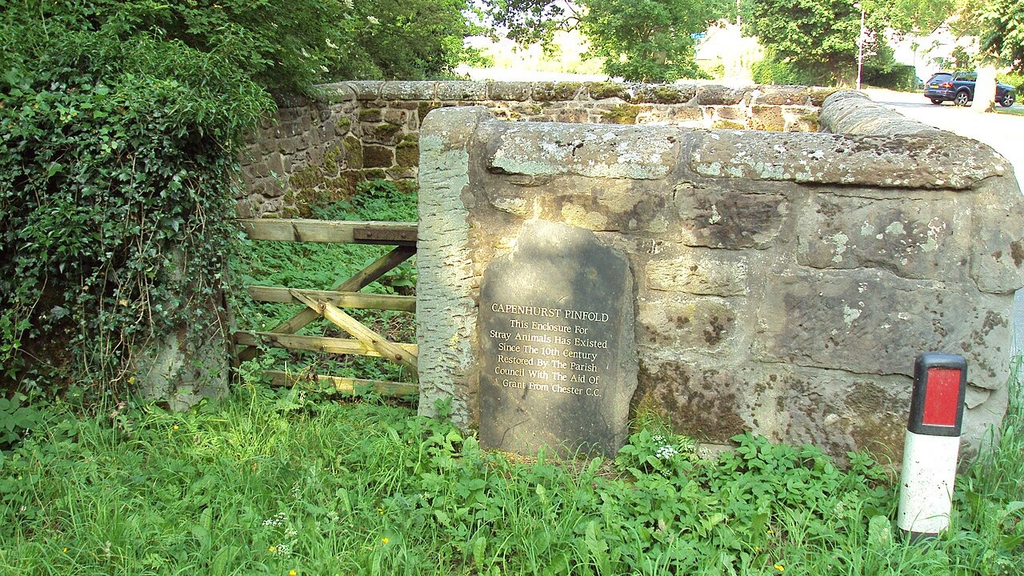
The village pound was built to hold stray animals. It also tells us something about local authority, mutual obligation and the difference between living in a place and having a say in it.
A cow gets into your crops.
Not a picturesque cow in a painting. A real animal, eating or trampling something you need.
Who sorts it out?
In an older English village, one answer might have been a local officer and a small enclosure beside the road.
The animal would be taken to the village pound. Its owner would have to reclaim it and meet the charges due. Where damage had been caused, there was also the question of compensation. Local arrangements varied, but the purpose was practical: somebody’s wandering livestock should not become somebody else’s unpaid loss.
That small enclosure, also called a pinfold, was part of the machinery of everyday England.
It was not grand. It did not need to be.
It existed because neighbours had rights, owners had responsibilities and somebody had to enforce the rules.
Look at it that way, and an old stone pen becomes rather more interesting.
It raises a question that reaches well beyond agriculture.
How much authority should a place have over the things that shape daily life within it?
What was a village pound?
A village pound was a secure enclosure used to confine stray or unlawfully grazing livestock. Historic England also records their use for gathering animals from common grazing at particular times of year. They belonged to the practical organisation of agricultural life, not simply the occasional recovery of an escaped sheep.
Some were built of stone. Others used brick or different stock-proof boundaries.
The remains can be easy to overlook: a low enclosure on a green, an odd corner beside a lane, something that looks like a fragment of an abandoned building.
There is a dating point worth remembering. An old institution does not necessarily mean an equally old wall. Historic England notes that most surviving pound structures are post-medieval, although the site may have been used for impounding animals for much longer.
In other words, the stones you can see may be a later version of an older arrangement.
The enclosure mattered because livestock mattered.
An animal could be valuable property to its owner and a serious nuisance to somebody else. A working system had to recognise both facts.
The pound provided somewhere to keep the animal while responsibility was established and the required payments were settled.
It turned an argument into a procedure.
That may not sound exciting.
But much of useful government consists of precisely that: making sure an everyday grievance has somewhere to go before it becomes a lasting feud.
The pinder: a local job with real consequences
In some places, the officer responsible was called a pinder.
Other names included poundkeeper, field keeper and hayward, although titles and duties were not identical everywhere. Local history records show how these roles could overlap in the supervision of animals and agricultural rules.
The pinder was not a decorative figure in a quaint rural scene.
The job concerned property, livelihoods and the enforcement of obligations.
Someone had to deal with the animal. Someone had to maintain or supervise the enclosure. Someone had to administer the charges.
The village could not solve the problem merely by agreeing that responsible livestock ownership was important.
It needed a person with a task.
That is one reason these small offices deserve attention. They show local authority in a form people could understand.
Not an ambition.
Not an announcement.
A job that had to be done.
There was a cow where it should not be. There was a recognised way of dealing with it.
The importance of that arrangement was not its simplicity alone. It was the connection between the problem and the institution responsible for addressing it.
The village was not an independent republic
The title of this article needs a qualification.
“Before Whitehall” does not mean England once consisted of free villages governing themselves without landlords, courts, taxation or a powerful Crown.
It means before the modern administrative state reached so deeply into ordinary life.
Much local business was handled through institutions rooted in a particular place. But those institutions existed within larger structures of authority, and some were distinctly unequal.
The manor is an obvious example.
The National Archives describes a manor as a landed estate administered by and for its lord, with its business conducted in the manor court before the steward. A manor might cover part of one parish, several parishes or scattered pieces of land. It was not necessarily the same thing as a village.
So “the village decided” can be misleading shorthand.
Who had standing?
Who held land?
Who could enforce a custom, and whose interests did that custom protect?
Those questions matter.
A rule can be local and still favour the powerful. A familiar official can still be unfair.
We should not exchange one comfortable myth for another.
But recognising inequality does not require us to dismiss the whole arrangement.
There is an important difference between saying older English communities were democratic by modern standards—which they were not—and recognising that they possessed institutions through which everyday obligations were defined and enforced.
The pound belonged to that world.
It was local government in a broad, practical sense, not a miniature modern council.
Common rights did not mean no rules
The pound also helps us understand something easily misunderstood about common land.
“Common” did not mean that anyone could do anything they liked.
Rights could concern particular uses: grazing animals, taking wood or other resources, with entitlements and restrictions varying from place to place. Historical parliamentary debates themselves distinguish between different interests in the same land, including pasture and woodland rights.
That is not an absence of ownership or authority.
It is a more complicated arrangement than a single owner exercising a single set of rights.
The same ground could matter to several people in different ways.
Such arrangements required boundaries, customs and enforcement. The pound was one practical part of that machinery.
This is where the wider lesson begins.
We often talk about rights and responsibilities as if they were competing ideas.
Here they were connected.
Your right to keep or graze an animal did not remove your responsibility for what it did to somebody else’s crops.
Your neighbour’s property mattered too.
A shared resource could only remain useful if there were limits to individual behaviour.
That is a harder understanding of community than the word sometimes carries now.
It does not mean everyone liked one another.
It means their lives were connected closely enough that conduct had consequences, and those consequences required rules.
Enclosure changed more than the shape of a field
The agricultural world in which pounds operated changed over centuries.
Enclosure reorganised open fields and land subject to common rights into more consolidated holdings. Parliamentary enclosure became the normal route from the 1750s, although enclosure had taken place through other means long before then.
The scale was substantial.
Parliament’s historical account records more than 5,200 enclosure Bills between 1604 and 1914, affecting approximately 6.8 million acres—just over a fifth of England’s total area.
This was not simply the appearance of a few additional hedges.
It changed how land was organised and how rights were exercised.
The parliamentary process generally allocated land according to recognised interests while extinguishing the old common rights covered by the award. The arrangements were not identical in every case.
That distinction matters because the effects were not identical either.
Enclosure could consolidate holdings, support agricultural changes and improve productivity. Parliament’s historical overview identifies significant productivity gains from the late eighteenth century.
But economic improvement is not the same question as who gained, who lost and who could afford to adapt.
Contemporaries understood that.
During an 1844 Commons debate, concern was expressed that enclosure could injure poorer people and remove access to open spaces. One speaker observed that even the right to turn a goose onto a common gave someone a connection with the land.
That is worth pausing over.
Not because keeping a goose answers modern England’s problems.
Because a small practical right could give a household something beyond permission to reside nearby.
It gave them a stake.
Enclosure should not be presented as the sole explanation for every pound’s decline. Animals still strayed, and local histories differed. But it transformed important parts of the agricultural system in which these institutions had operated.
To understand a particular pound, we need its particular records—not just a national story laid over the stones.
Belonging needs more than a name on an address
What interests me most is the relationship between belonging and responsibility.
We use “community” very freely.
A new development is called a community before anyone has moved into it. A consultation speaks on behalf of a community whose members may disagree profoundly.
But sharing an address or an administrative boundary does not automatically give people a meaningful role in shaping a place.
Older village institutions offer something more demanding to consider.
There were specific rights.
Specific obligations.
Specific people carrying out specific tasks.
Those arrangements could be restrictive, unequal and open to abuse. Yet they made certain relationships visible.
The person whose animal caused damage could be held responsible. The person suffering the loss had a recognised route to seek redress.
The lesson is not that familiarity guarantees justice.
It is that responsibility should be clear enough for people to understand and close enough for them to question.
That is a useful test for any institution, old or new.
Who makes the decision?
Who lives with its consequences?
And what can those affected actually do about it?
When I look at the village pound, those are the questions it brings to mind.
What should England take from this now?
Not a return to medieval government.
Nor a claim that every decision belongs at parish level.
Some protections need national enforcement. Local majorities can mistreat minorities. Wealth and influence do not become harmless because their owners live nearby.
But none of that makes distance a virtue in itself.
A sensible modern argument is that decisions should be made at a level appropriate to the problem, with clear responsibility and meaningful ways to challenge them.
That means asking more of local power as well as central power.
A local body should have enough authority to do its job. It should also explain its decisions, account for its spending and listen to people without treating consultation as a box already ticked.
National government should be judged by the same principle.
It is not enough to announce local empowerment if the important choices have already been settled elsewhere.
For me, the historical value of the pound lies here.
It shows an institution attached to a recognisable problem, with a practical function in the place it served.
We should be capable of expecting that much from modern institutions too.
This is why the subject belongs within Everyday England: Then and Now. The history of ordinary life is also a history of how people organised their dealings with one another: work, property, customs, disputes and obligations.
Those things helped give a place its character.
They also determined how much room people had to act within it.
An old institution can still bring people together
There is a recent example that keeps this story from ending in simple loss.
In Arlingham, Gloucestershire, around 70 volunteers helped restore a historic animal pound after the parish council acquired the site in 2023. The project included sorting and reusing stones, constructing a gate and uncovering original cobbled flooring. Reporting in July 2024 put the restoration cost at £23,000, funded through grants.
The parish council also planned to recreate an eighteenth-century sign setting out charges for releasing livestock.
That detail says something.
The volunteers were not restoring the pound because the village urgently needed somewhere to impound cattle.
They were restoring evidence of how their place had worked.
People took responsibility for a shared piece of history. They contributed time and effort to something whose value was not measured simply by its original use.
The old institution had acquired a new purpose.
It helped people act together in the present.
That seems to me a better understanding of continuity than either preserving everything untouched or dismissing anything that no longer performs its first job.
A place can change and still keep hold of its story.
Conclusion: where does responsibility live?
The village pound was built to hold animals.
We should not ask it to prove that the whole of old England was fairer, freer or better governed.
But neither should we dismiss it because the world that produced it was imperfect.
It is evidence that many practical matters were once managed through institutions rooted in local life—institutions operating within wider systems of landholding, law and authority.
The question it leaves us is not whether we would prefer to live in the Middle Ages.
It is whether the institutions governing our own daily lives have a purpose we can understand, responsibilities we can identify and people we can hold to account.
A pinder could not answer every problem.
But there was no great mystery about what the job was for.
Can we always say the same now?
If your village has a pound, pinfold or a surviving place name connected with one, find out what the local records say. Its story may be more particular—and more revealing—than a general account can tell.
And if you know who maintains it today, that is part of the story too.